

You may not need new cabinet doors to get a quieter, controlled close. Upgrading to soft-close cabinet hinges in Del Mar can work with existing doors when the hinge style and hole layout are compatible. Concealed European-style hinges can often reuse their cup holes, while converting from surface-mount hinges to concealed hinges requires drilling a 35 mm cup hole in each door.
If cabinet doors that slam or rattle are wearing on your kitchen, upgrading to soft-close cabinet hinges in Del Mar can make everyday use quieter and reduce repeated impact on doors and frames. The right fit depends on the cabinet construction, door overlay, and existing hinge layout, so replacement is not always a simple swap.
This guide explains how a professional assesses hinge compatibility, installs and adjusts soft-close hinges, and determines whether an upgrade makes sense. You’ll also learn how the closing mechanism works, what affects the result, and when a broader cabinet update may be a better fit.
Key Takeaways
- A professional can assess the door, cabinet construction, and existing hinge layout to determine whether an upgrade can use the current doors.
- Correct hinge selection and careful adjustment help doors close smoothly without bouncing or stopping short.
- Soft-close hinges reduce slamming and noise, making everyday kitchen use quieter and helping limit stress on cabinet components.
- When hinge changes aren’t enough to achieve the kitchen you want, cabinet refacing or a broader kitchen update may be worth considering.
Can a professional install soft-close hinges on my existing cabinet doors without replacing them?
Often, yes. A professional can assess the doors, cabinets, and hinge layout to determine whether the existing doors can remain.
-
How an Installer Identifies the Overlay and Hinge Type
The installer checks how each door sits against the cabinet frame to identify its overlay: full, half, or inset. They also note whether the cabinet is face-frame or frameless and whether the hinges are surface-mounted or concealed European-style. These details guide hinge selection. Hinges that look similar may not fit the same way.
-
How an Installer Checks Hinge and Mounting Plate Compatibility
The installer measures the concealed hinge cup and checks its hole spacing against the replacement hinge. Existing cup holes may be reused when the replacement has the same cup size and spacing. When possible, matching the hinge brand to the existing mounting plate can avoid redrilling. The installer also checks plate position and overlay to ensure the door aligns when closed.
-
How an Installer Converts or Replaces the Existing Hinges
For a surface-mount-to-concealed conversion, the installer removes the old hinges and drills a 35 mm cup hole in each door. This changes the door, so accurate placement matters. With existing concealed hinges, the installer can replace them in the same mounting style and reuse compatible holes. Retrofit soft-close adapters may preserve the current hinges with less alteration, but replacement gives the installer a chance to address hinge fit and wear together.
-
How an Installer Attaches Hinge Cups and Mounting Plates
The installer uses measuring and drilling tools, followed by a screwdriver, to secure the cups in the doors and the plates to the cabinet. They align the doors and adjust the hinges to correct gaps or uneven positioning. If a mounting screw strips the wood, a small wood plug can help restore its hold before the screw is refitted. Misalignment, damaged holes, and incompatible spacing are common fit problems addressed during installation and adjustment.
Cabinet hardware installation and maintenance
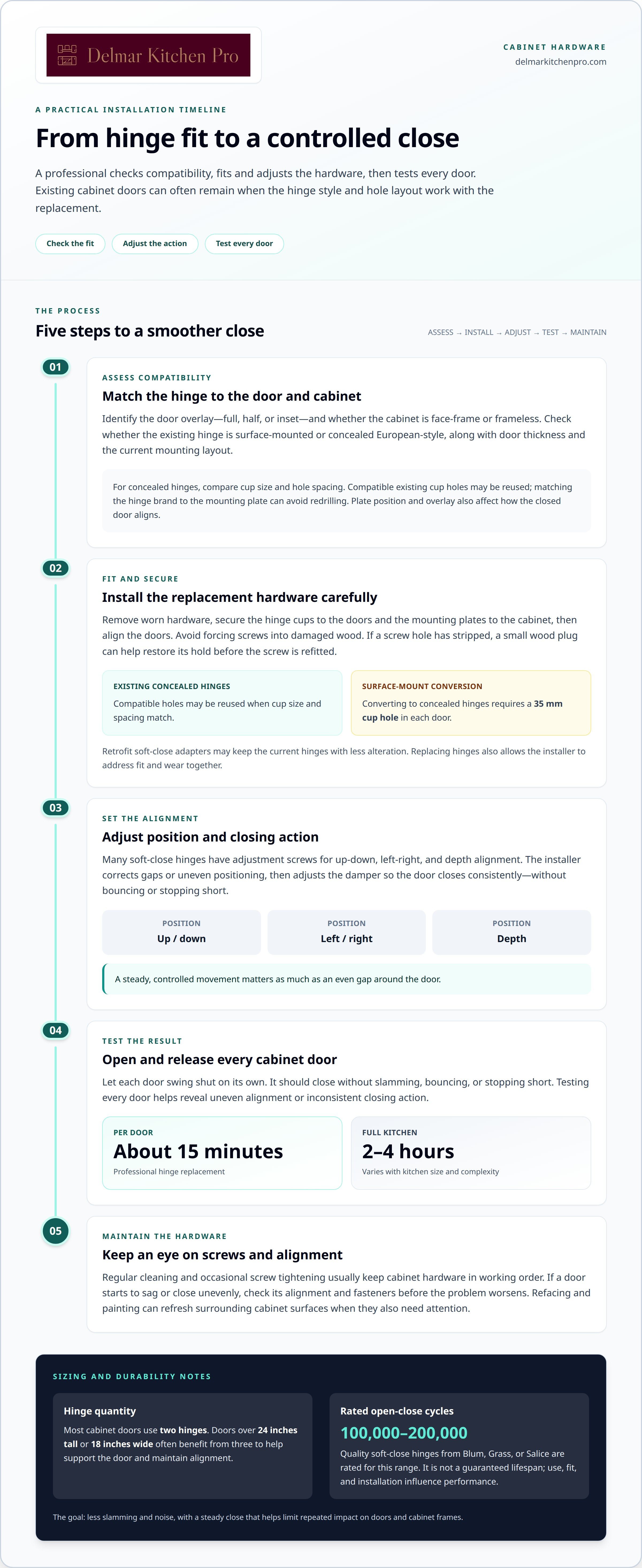
A professional considers hinge fit, door alignment, and closing action together. The steps below outline the work, from selecting hardware to final testing.
- Match the hinge to the door. The installer selects cabinet hardware that suits the door thickness, overlay, and cabinet construction. Most cabinet doors use two hinges. Doors over 24 inches tall or 18 inches wide often benefit from three, which helps support the door and maintain alignment.
- Fit and secure the replacement hinges. The installer removes worn hardware, attaches the replacement hinges, and secures each mounting point without forcing screws into damaged wood. A cabinet installer is especially useful when the work involves converting hinge styles, correcting alignment, or addressing loose attachment points.
- Adjust the closing action. Many soft-close hinges have adjustment screws for up-down, left-right, and depth alignment. The installer positions the door, then adjusts the damper so it closes consistently without bouncing or stopping short. A slow, controlled movement matters as much as an even gap around the door.
- Test every door. The installer opens each cabinet door and lets it swing shut on its own. It should close without slamming. Professional hinge replacement takes about 15 minutes per door, while a full kitchen can take 2-4 hours, depending on its size and complexity.
- Maintain the hardware. Regular cleaning and occasional screw tightening usually keep cabinet hardware in working order. If a door begins to sag or close unevenly, the installer can check its alignment and fasteners before the problem worsens. If worn cabinet surfaces also need attention, cabinet refacing and painting can refresh the surrounding finish.
Reasons to upgrade to soft-close hinges
For homeowners upgrading to soft-close cabinet hinges in Del Mar, the strongest reason is a daily improvement in how the kitchen feels. The decision makes most sense when abrupt closing creates noise, disrupts nearby activities, or makes cabinets feel harsh in use.
- Make busy kitchens quieter. A soft-close hinge controls the door’s final movement, reducing the impact that causes slamming. This can make a noticeable difference when someone closes a cabinet while others are talking or preparing food nearby. If noise is your main concern, consider which doors get used most throughout the day.
- Reduce repeated impact on cabinetry. Controlled closing can reduce stress on cabinet frames, hinges, and doors. It will not fix existing damage, but it can soften the repeated force of hard closing. The difference matters most when doors are often pushed shut rather than guided closed.
- Weigh hinge durability sensibly. Quality soft-close hinges from Blum, Grass, or Salice are rated for 100,000 to 200,000 open-close cycles. A rating helps compare hinge options, but it isn’t a guaranteed lifespan for every kitchen. Use, fit, and installation all influence how the hardware performs.
- Notice the difference in everyday handling. A controlled close gives a cabinet door a steadier finish instead of an abrupt stop. This can be especially useful near a kitchen workspace, where several doors may be opened and closed during one task. Consider which routines and areas of the kitchen are affected by the sound.
- Choose the upgrade for a clear reason. Upgrading to soft-close cabinet hinges in Del Mar is worthwhile when slamming, noise, or forceful door movement regularly bothers you. If your doors already close quietly and the hardware works properly, the change may offer less value. Let the kitchen’s condition and everyday use guide your decision.
What cabinet hinge types are compatible with soft-close replacements?
Compatibility depends on cabinet construction, door overlay, and hinge geometry. A replacement must fit the cabinet and door, not simply include a soft-close damper.
- Identify the cabinet construction. Face-frame cabinets have a front frame around the cabinet opening; frameless cabinets do not. They require different hinge types because the hinge attaches to different cabinet surfaces. An installer identifies the construction before selecting a soft-close replacement, avoiding hardware that cannot mount correctly.
- Match the door overlay. Determine whether each door has full, half, or inset overlay. Full-overlay doors cover most of the cabinet frame, while inset doors sit within the opening. Half-overlay doors share a frame area with an adjacent door. The soft-close hinge must suit the door’s position, so one hinge style may not fit every cabinet in the kitchen.
- Check the existing hinge format. Concealed European-style hinges use a cup set into the door, while surface-mount hinges attach visibly to the door and cabinet. For concealed replacements, cup size and hole spacing determine whether existing openings align. For surface-mount setups, the installer checks the mounting arrangement and door clearance before selecting a compatible soft-close option.
- Choose the opening angle for the cabinet. Standard cabinet hinges typically open 95-110 degrees. Wide-angle hinges typically open 165-170 degrees, which can provide more access where nearby walls or cabinet placement restrict movement. The installer considers the door’s swing path and surrounding fixtures, then selects an opening range that suits the kitchen layout.
- Match hinge capacity and door dimensions. Hinge selection also depends on door thickness and weight. Standard hinges suit typical doors weighing up to 15-20 lbs, while heavy-duty hinges are designed for large or thick doors weighing 30+ lbs. For help planning a cabinet update around compatible hardware, explore cabinet options.
Delmar Kitchen Pro: Cabinet Reface & Paint
Delmar Kitchen Pro can help when a hinge upgrade addresses the noise but not the kitchen’s worn appearance. Cabinet Reface & Paint refreshes existing cabinetry, while new cabinets may suit a space that needs a broader change. For a larger renovation, a Luxury Custom Kitchen can bring the cabinetry and overall design together. Counter Options can also be part of the update.
The right next step depends on what you want to improve: the closing action, cabinet appearance, or the kitchen as a whole. A focused refresh may be enough if the cabinet layout still works. If the space needs more substantial changes, a larger kitchen project may better match your goals.
Contact Delmar Kitchen Pro to discuss your kitchen plans.
Plan the Next Kitchen Improvement
If you’re considering upgrading to soft-close cabinet hinges in Del Mar, decide whether quieter doors are the whole goal or part of a wider kitchen refresh. If the cabinet layout still suits your home, a focused change may be enough. If the doors or finishes feel dated too, consider how updated cabinetry could bring the room together.
Delmar Kitchen Pro offers Cabinet Reface & Paint to refresh existing cabinetry, along with Cabinets and Luxury Custom Kitchen options for broader changes. The right direction depends on your kitchen’s condition and the result you want to live with every day.
Share your kitchen plans and discuss the scope that fits them. Contact Delmar Kitchen Pro to take the next step toward a kitchen that feels right for your home.
Frequently Asked Questions
Need the Right Hardware?
Choose soft-close hardware that matches the cabinet construction, door overlay, and existing hinge arrangement. For example, a replacement that fits a full-overlay door may not suit an inset door. A cabinet installer can assess how the door sits and swings, then identify compatible hardware. Matching these details helps prevent ordering a hinge that cannot align with the cabinet or door.
What Do Homeowners Ask About Soft-Close Upgrades?
Homeowners often ask whether a worn damper means replacing the entire hinge. For many quality hinge lines, replacement damper cartridges are available, so a new cartridge may restore the soft-close action without replacing the full hinge. The specific hinge line matters. Also consider whether the doors close evenly and whether the upgrade suits the kitchen’s everyday use.
What’s Included in This Service?
A professional hinge replacement generally involves assessing the current setup, selecting compatible hardware, fitting the hinges, and adjusting the doors. The installer can also identify issues such as loose screw holes or uneven door gaps that affect the result. The work depends on the existing cabinets and the project scope. Delmar Kitchen Pro’s kitchen services focus on cabinet refacing and painting, cabinetry, and kitchen design and construction.
How Much Does It Cost to Upgrade Cabinet Hinges to Soft-Close in Del Mar, CA?
There is no single price for every Del Mar kitchen. Cost depends on factors such as the number of doors, whether existing holes fit the replacement, the need for new drilling, and any repair or alignment work. Converting from surface-mount hinges may involve more work than replacing compatible concealed hinges.
Can a Professional Install Soft-Close Hinges on Existing Cabinets Without Drilling New Holes?
Often, yes, if the replacement matches the existing hinge cup size and hole spacing. That can let the installer reuse the current openings. A surface-mount-to-concealed conversion is different: it requires a 35 mm cup hole in each door. The installer also checks the mounting plate and overlay, since mismatched hardware can prevent the door from sitting correctly.
How Long Does a Soft-Close Hinge Installation Take, and What Affects the Price?
The time required depends on how many doors are involved and how much adjustment each one needs. Existing holes that fit the new hinges can simplify the work, while drilling, stripped screw holes, or uneven cabinet alignment can add steps. Similar factors affect the project scope, including door count, hinge compatibility, and repairs. An installer considers these details together when defining the work.


