

The countertop that looks perfect in a showroom may not be the best fit for your kitchen. A small sample can’t show how a surface will work with your cabinets, stand up to daily routines, or look across an entire island. Comparing kitchen countertop options means considering more than appearance.
Material descriptions can feel technical. Natural stone, engineered surfaces, porcelain, and butcher block each have distinct visual qualities and care needs. The right choice depends on how you use your kitchen, the look you want, and how the countertop will work with your cabinetry and layout.
This guide compares popular countertop materials by composition, appearance, everyday use, and maintenance. You’ll also find a practical way to narrow your choices and coordinate a selection with the rest of your kitchen. Understanding the trade-offs makes it easier to choose a surface that suits your home beyond the sample board.
Key Takeaways
- Choose kitchen countertop options by weighing appearance, daily use, and care needs rather than searching for one universally best material.
- Compare materials by composition, visual character, routine care, and practical limitations to understand how their differences affect your kitchen.
- Use a five-step selection plan to set priorities, narrow materials, review upkeep, compare samples, and coordinate the final design.
- Assess countertop samples alongside your cabinets and layout to see how the materials work together across the whole kitchen.
- Plan countertop decisions as part of the broader kitchen design so the surface, cabinetry, and construction contribute to a cohesive result.
Kitchen countertop options: start with how your kitchen works
The right countertop isn’t simply the one with the most dramatic pattern or the strongest reputation. It’s a surface that suits your routines and feels at home with the rest of the kitchen. A household that cooks often may prioritize cleanup and care differently from one that uses the kitchen lightly. Start with how you live to narrow the choices without searching for a universal “best.”
A countertop is both a work surface and a major visual element. The countertop material is what the surface is made of; its finish describes its appearance and feel, its edge is the exposed profile, and installation describes how it is fitted in the kitchen. Separating these details helps you compare the material itself with the design choices around it.
What matters most in a kitchen countertop?
Consider your cooking habits, cleanup preferences, and how heavily the kitchen is used. Do you want to wipe down the surface quickly after frequent meal preparation, or are you comfortable following material-specific care instructions? Think about visual character, too. Color, pattern, and texture can make a countertop a quiet backdrop or a focal point.
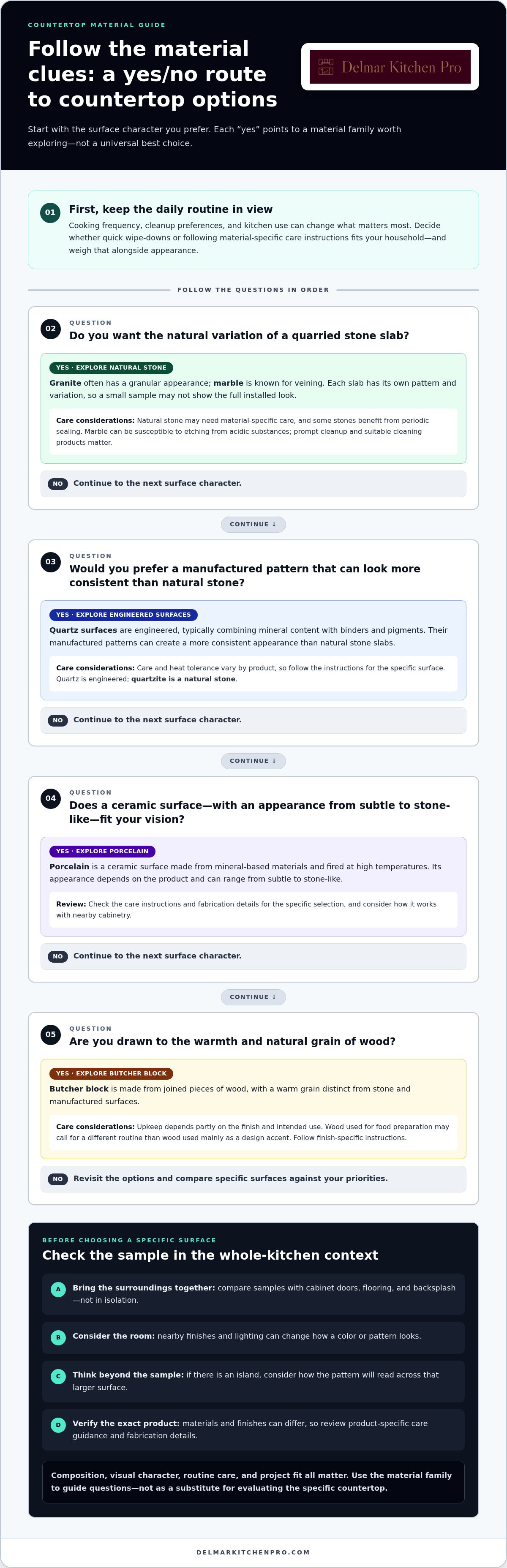
Compare samples with your cabinet doors, flooring, and backsplash rather than viewing them alone. Nearby finishes and room lighting can change how a color or pattern looks. If your kitchen has an island, consider how the pattern will read across that larger surface, not just along the perimeter.
Which countertop material families should you compare?
Compare material families before choosing by color name alone. Natural stone includes granite and marble, both with their own pattern variation and care considerations. Engineered surfaces are manufactured materials, not natural stone. Porcelain and wood are distinct categories with different visual qualities and practical considerations. This overview of kitchen countertop materials can help clarify the range.
These categories aren’t interchangeable. Composition affects appearance and may influence care, while the layout and overall design help determine what suits the project. Use this comparison as a starting point:
- Natural stone: Compare the pattern of the individual stone and consider whether its care suits your routine.
- Engineered surfaces: Review the manufactured appearance and care guidance for the specific product.
- Porcelain: Consider its distinct surface character and how it fits the kitchen’s overall design.
- Wood: Weigh the warmth of the grain against the care required for the selected finish.
Use these categories to guide a comparison, not as a substitute for reviewing a specific surface. Looking at composition, appearance, care, and project fit gives you a more useful basis for choosing a countertop that works with both your routines and your kitchen design.
Compare kitchen countertop materials by composition and care
Material names tell only part of the story. To compare kitchen countertop options, look at four points for each surface: what it’s made of, how its pattern appears, what routine care it needs, and what practical considerations may affect daily use. Care can vary by product and finish, so use the manufacturer’s guidance alongside general information about the material family.
Composition can help you identify the care questions to ask, including how a surface should be cleaned and whether it has specific maintenance instructions. Materials within one category aren’t necessarily identical, so review the information for the exact countertop you’re considering.
How do natural stone and engineered surfaces differ?
Granite and marble are natural stones cut from quarried material. Each slab has its own mineral pattern and variation, so the installed surface may look different from a small sample. Granite often has a granular appearance, while marble is known for veining. Natural stone may require material-specific care, and some stones benefit from periodic sealing. Marble can be susceptible to etching from acidic substances, so prompt cleanup and suitable cleaning products matter.
Quartz surfaces are engineered, typically combining mineral content with binders and pigments. Their patterns are manufactured, which can create a more consistent appearance than natural stone slabs. Quartz is not the same material as quartzite, which is a natural stone. Care and heat tolerance vary by product, so follow the instructions for the selected surface rather than assuming all quartz countertops behave alike.
What should you know about porcelain and wood countertops?
Porcelain is a ceramic surface made from mineral-based materials and fired at high temperatures. Its appearance can range from subtle to stone-like, depending on the product. Review the care instructions and fabrication details for the specific selection, then consider how its appearance works with nearby cabinetry.
Butcher block is made from joined pieces of wood, with a warm, natural grain distinct from stone and manufactured surfaces. Its care depends in part on the finish and intended use. A surface used for food preparation may call for a different routine than wood used mainly as a design accent. Follow the finish-specific instructions and consider whether the upkeep fits your household.
- Composition: Identify whether the surface is natural stone, engineered, ceramic, or wood.
- Visual character: Compare natural variation with more controlled or uniform patterns.
- Routine care: Review cleaning, sealing, and finish-specific instructions.
- Practical fit: Consider where the surface will be used and the care you’re prepared to give it.
Material comparisons are more useful when you view the options alongside the cabinets and the room’s design. Delmar Kitchen Pro brings countertop selections into a coordinated kitchen plan for homeowners in San Diego, Encinitas, Rancho Santa Fe, La Jolla, and Del Mar. Explore custom kitchen design and countertop solutions as part of the wider project.
Is there one best kitchen countertop? Compare the trade-offs
No single countertop material suits every household. A surface that works for a busy cook who values simple cleanup may not appeal to someone who prefers natural variation or the warmth of wood. Separate details you can verify, such as composition and care instructions, from choices based on your taste and routine. Compare what each material adds to the room and what it asks of your household, rather than declaring one universal winner.
The table is a starting point, not a performance guarantee. Care needs can differ by product, finish, and manufacturer guidance. “Daily-use fit” points to questions worth considering, not a promise that a material suits every kitchen.
| Material | Visual variation | Care considerations | Daily-use fit and design compatibility |
|---|---|---|---|
| Granite | Natural patterns and color can vary between slabs. | Care, including whether sealing is recommended, depends on the stone. | Consider whether natural variation works with your cabinets and overall design. |
| Marble | Natural veining gives each slab distinct character. | Acidic substances can etch marble; use care guidance suited to the stone. | Its veining can stand out or complement other established finishes. |
| Engineered quartz | Manufactured patterns can appear more consistent than natural stone. | Follow the specific product’s cleaning and heat-care instructions. | Consider whether a controlled pattern supports your preferred visual balance. |
| Porcelain | Available looks vary by surface and design. | Use care instructions specific to the product and finish. | Compare its appearance with the cabinetry and other fixed finishes. |
| Butcher block | Wood grain brings visible, natural variation. | Care depends on the wood finish and how the surface is used. | Consider whether its warmth and upkeep suit the kitchen’s intended use. |
Which trade-offs matter in everyday use?
Picture the ordinary rhythm of your kitchen: meal preparation, spills, and cleanup. Be realistic about the care you’ll maintain over time. A surface with product-specific cleaning or maintenance may still suit you if the routine feels manageable. When possible, view a larger sample or slab. Pattern scale and finish can look different once the material covers a full counter.
How should the countertop work with the rest of the kitchen?
Place samples beside cabinet colors, flooring, and other fixed finishes, then view them in the room’s lighting. A strongly patterned countertop can become a focal point, while a quieter surface may let the cabinetry draw the eye. For more context on coordinating finishes and the overall room, explore this luxury kitchen design guide. The right balance is the one that supports your priorities and feels cohesive in your home.
Choose kitchen countertop options with a practical five-step plan
A clear process makes a countertop decision easier to manage. Start with how the kitchen needs to function, then narrow the materials and assess them in the room. Include cabinet condition, layout, and intended use in your planning. These details can shape both the surface choice and the scope of a wider renovation.
- List your priorities. Write down what matters most, such as a particular look, straightforward cleanup, or suitability for frequent cooking. Rank your priorities instead of treating every preference as equally important. This gives you a practical basis for comparing kitchen countertop options.
- Shortlist materials. Use your priorities to identify a few material categories worth considering. Set aside options that don’t suit your preferred appearance or care routine. A focused shortlist is easier to assess than a large set of unrelated samples.
- Review care. Read the care guidance for each shortlisted surface. Note cleaning steps, finish-specific instructions, and ongoing maintenance. Decide whether that routine fits the way your household uses the kitchen.
- Compare samples. View samples beside your existing or planned cabinets, flooring, and backsplash. Check them in the kitchen’s lighting, and consider how a pattern will look across the full counter rather than in a small swatch.
- Coordinate the design. Bring the surface choice together with cabinet condition, layout, and intended use. Confirm that the countertop supports the overall plan, including its visual balance and the arrangement of work areas.
How do you narrow the material shortlist?
Begin by ranking appearance, cleaning preferences, and household use. If simple upkeep is a priority, compare the written care instructions before focusing on color. If a particular visual character matters most, compare patterns and finishes in context. Removing materials that conflict with your main priorities keeps the decision manageable. Revisit your shortlist alongside the finishes already in the room or planned for the remodel.
How do you plan countertop and cabinet coordination?
Review cabinet color, wood tone, and countertop pattern together. A strong pattern can carry visual weight, while a restrained surface may let detailed cabinetry stand out. Assess cabinet condition as well: keeping, refacing, painting, or replacing cabinets can affect the project plan and the finishes you’re coordinating. For ideas on how cabinetry shapes the room, see this custom wood kitchen cabinets guide and the contemporary kitchen remodel guide.
Countertop planning works best as part of a coordinated kitchen design and construction plan. Explore countertop solutions for your kitchen project with Delmar Kitchen Pro.
Make countertop selection part of a complete Delmar kitchen plan
A countertop is part of a connected set of decisions. Its color and pattern meet the cabinets, its dimensions relate to the layout, and its intended use should suit the way the kitchen works. Considering the surface alongside these other elements makes it easier to see how the finished room will come together.
Delmar Kitchen Pro provides custom kitchen design and construction, cabinet services, and countertop solutions for homeowners in San Diego, Encinitas, Rancho Santa Fe, La Jolla, and Del Mar. The company is privately owned and operated by a licensed contractor, License #892702, with more than 25 years of industry experience. This project-wide perspective brings countertop options into the same conversation as cabinetry, layout, and your priorities.
What does a coordinated countertop and cabinet plan accomplish?
Reviewing cabinet and countertop selections together helps you assess the finished combination, not just two attractive samples. A countertop pattern may stand out against simple cabinet fronts, while detailed cabinetry may pair better with a quieter surface. Wood tone and cabinet color also affect how a countertop’s color reads. The right pairing depends on the room, planned finishes, and the atmosphere you want to create.
Coordination is practical, too. Cabinet condition and project scope can affect the renovation plan. If cabinets are staying, the countertop needs to work with their existing finish and layout. If the cabinetry is changing, both selections can be considered as part of the same design and construction process. The kitchen’s condition and your project goals guide which approach makes sense.
How can San Diego-area homeowners take the next step?
Bring the main decisions into one project conversation: what the kitchen needs to do, what is happening with the cabinets, and what overall look you want to achieve. Then consider how the countertop supports those choices. Delmar Kitchen Pro connects custom design, kitchen construction, cabinet services, and countertop solutions so homeowners can consider these elements as parts of a complete plan.
Keep the discussion grounded in your kitchen. The layout, existing conditions, household routines, and design priorities all shape which combinations make sense. You don’t need to settle on a material before the rest of the plan is clear. A coordinated approach lets you weigh the options with the whole room in view.
For a kitchen project in San Diego, Encinitas, Rancho Santa Fe, La Jolla, or Del Mar, explore a coordinated kitchen design and countertop plan with Delmar Kitchen Pro.
Take the next step toward a kitchen that feels complete
Before choosing among kitchen countertop options, decide which parts of the project are fixed and where you can still make changes. Note what you plan to keep, what needs attention, and what you want the finished kitchen to make easier. This gives the design conversation a useful starting point and connects individual selections to the larger goal.
A custom kitchen plan can bring those priorities into one clear direction. Delmar Kitchen Pro combines kitchen design and construction with cabinetry and countertop solutions, shaping the plan around the home and homeowner’s needs. You don’t need every finish decided before you begin.
Explore a custom kitchen plan with Delmar Kitchen Pro and start shaping a kitchen that feels considered, comfortable, and truly yours.
Frequently Asked Questions
Is quartz a natural stone?
No. Quartz countertop surfaces are engineered, not cut as a single slab of natural stone. They commonly combine quartz particles with binding materials, though the exact composition varies by product. This manufacturing process can produce patterns with a more consistent appearance than natural stone. When comparing samples, review the product specifications and care instructions rather than assuming every quartz surface has the same makeup or requirements.
Can granite countertops stain?
Yes, granite can stain, though the likelihood depends on the slab and its finish. A spill left on one granite surface may behave differently on another. Clean up spills promptly and follow care guidance for the specific countertop, including any instructions about sealing or suitable cleaners. The selected stone’s recommendations are more useful than a general rule for all granite.
Do marble countertops require sealing?
Some marble surfaces may be recommended for sealing, but there isn’t one schedule that applies to every slab. The stone, finish, and product guidance all matter. Before selecting marble, review the care routine for the specific surface and consider whether it suits your household. A household that prefers minimal upkeep may weigh that differently from one that values marble’s distinctive veining and is comfortable following its care recommendations.
Can you install a new countertop without replacing the cabinets?
Yes, a new countertop can sometimes be planned around existing cabinets, so cabinet replacement isn’t automatic. The condition of the cabinet boxes, the layout, and their suitability for the planned surface help determine the project scope. If cabinets need attention, refacing or painting can be part of the wider design plan. Delmar Kitchen Pro works on kitchen projects in San Diego, Encinitas, Rancho Santa Fe, La Jolla, and Del Mar, integrating cabinetry and countertop choices into the project.
Are seams visible in kitchen countertops?
They can be. How noticeable a seam looks depends on the material, pattern, layout, and where the pieces meet. A strong pattern may make a seam less obvious in one location but more apparent in another. During layout planning, consider sightlines from main entrances and seating areas as well as the work surface. Plan seam placement thoughtfully rather than expecting every seam to disappear.
Can you combine two countertop materials in one kitchen?
Yes, different countertop materials can be used in separate areas, such as an island and perimeter counters. Give each surface a clear purpose in the design. For example, one material might define the island visually while another keeps the perimeter more restrained. Compare colors and finishes together, and consider whether each material’s care routine suits its intended use.
Do countertop edge profiles change the look of a kitchen?
Yes. An edge profile changes the visible outline of the countertop and can influence whether the finished installation feels formal, simple, or detailed. A restrained edge may suit cabinetry with strong visual details, while a more pronounced profile can add definition to simpler cabinets. Review the edge alongside the cabinet door style and countertop thickness so the choice feels intentional across the room.


