

Natural stone isn’t automatically the better countertop for a coastal home. Choosing quartz vs quartzite countertops for coastal homes comes down to priorities: quartzite offers natural veining, varied color, and greater hardness, while engineered quartz has more consistent patterns and a nonporous surface that doesn’t need sealing. Choose quartzite for distinctive natural character if you’re comfortable with periodic sealing; choose quartz for a more uniform look and simpler upkeep.
Both materials can create a polished kitchen, but their differences affect appearance and care. The right choice should suit your home’s style and stand up to everyday use.
This guide compares appearance, color consistency, hardness, and scratch resistance, then offers a practical decision guide. Use it to weigh the trade-offs against your design preferences and maintenance priorities.
Key Takeaways
- Choose quartzite for natural veining and one-of-a-kind color variation; choose quartz when a more consistent pattern matters.
- Compare hardness and scratch resistance alongside everyday care needs before deciding which surface suits your kitchen.
- Weigh your design preferences against maintenance: natural stone may need periodic sealing, while engineered quartz offers a nonporous surface.
- Use the material choice to guide your wider kitchen design, including how the countertop works with cabinets and the overall layout.
Appearance, veining, and color consistency
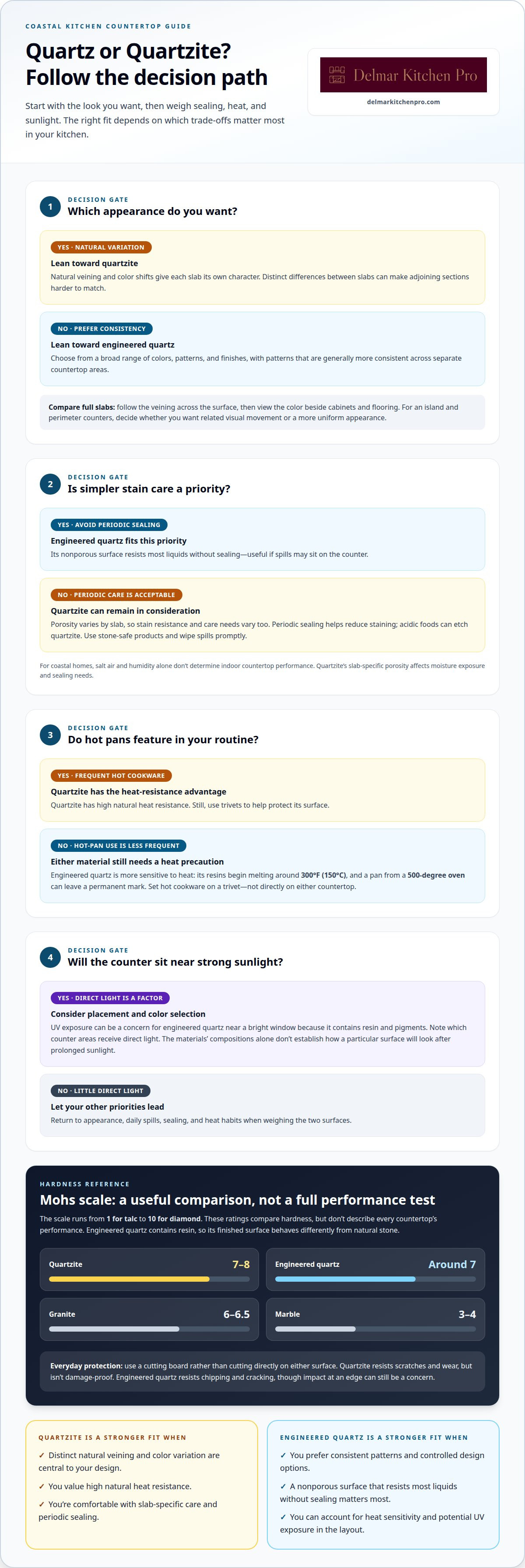
This comparison of quartz vs quartzite countertops for coastal homes starts with the visual effect you want. Quartzite brings natural variation, while engineered quartz offers more consistent patterns across a kitchen.
Natural Versus Engineered Appearance
Natural quartzite has distinct veining and color shifts, giving each slab its own character. One slab may have broad, sweeping lines; another may show finer movement. That variation can make adjoining sections harder to match. Engineered quartz combines pigments and crushed quartz for a more controlled appearance, with patterns that are generally more consistent across separate countertop areas.
Appearance and Design Options
Engineered quartz comes in a wide range of colors, patterns, and finishes, from a quiet, even background to a pronounced stone-like look. Quartzite’s design options depend on the natural slabs available, each with its own color balance and veining. When comparing quartz vs quartzite countertops for coastal homes, consider whether coordinated consistency or natural variation better suits your design.
| Option | Appearance | Slab consistency |
|---|---|---|
| Quartzite | Natural veining and color variation | Distinct differences between slabs |
| Engineered quartz | Broad choice of colors, patterns, and finishes | More consistent patterns |
Compare full slabs rather than relying only on small samples. Follow the veining across the surface, then view the color beside your cabinets and flooring. For an island and perimeter counters, decide whether you want related visual movement or a more uniform appearance. This helps you see how natural variation or a manufactured pattern will look across the finished kitchen.
Choose quartzite if natural variation is central to your design; choose engineered quartz if pattern consistency and controlled design options matter more.
Hardness and scratch resistance
Quartzite handles heat better, while engineered quartz resists stains without sealing. Quartzite’s stain resistance varies with slab porosity, so its care needs depend on the stone. Each material has different vulnerabilities, so consider heat, pressure, spills, and your daily habits when choosing.
The Mohs scale runs from 1 for talc to 10 for diamond, according to the U.S. Geological Survey. Quartzite rates 7-8 on this scale, while quartz rates around 7. These ratings offer a useful comparison, but they don’t describe every countertop’s performance. Engineered quartz also contains resin, and the finished surface behaves differently from natural stone.
For scratch protection, use a cutting board rather than cutting directly on either countertop. Quartzite is highly resistant to scratches and wear, but a hard surface isn’t damage-proof. Engineered quartz resists chipping and cracking, though impact at an edge can still be a concern. Granite rates 6 to 6.5 on the Mohs scale, giving homeowners another familiar reference point for hardness.
Heat requires a separate precaution. Quartzite has high natural heat resistance, but trivets help protect its surface. Engineered quartz is more sensitive: its resins begin melting around 300°F (150°C), and a pan from a 500-degree oven can leave a permanent mark. Set hot cookware on a trivet, not directly on either material.
Engineered quartz is nonporous and resists most liquids without sealing. Quartzite varies in porosity, so its stain resistance depends on the slab. Periodic sealing helps reduce staining, and acidic foods can etch quartzite. Use stone-safe products and wipe spills promptly to protect the surface.
Compare the key differences against your cooking habits: frequent hot-pan use favors quartzite’s heat resistance, while lower-sealing upkeep favors quartz. Counter options can help you weigh scratch, heat, and stain priorities in your kitchen project.
Quartz vs Quartzite: What’s the Difference and Which Should You Choose?
For a busy kitchen, consider your care habits, sunlight, and preferred look. The best surface balances everyday use with the beauty and durability you value.
Choosing for Household Needs and Lifestyle
Start with your household’s routine. A kitchen used for daily cooking may benefit from engineered quartz’s nonporous surface, which resists most liquids without sealing. Quartzite suits homeowners who value natural stone and accept periodic sealing. If spills often sit on the counter, simpler stain care may matter most; if natural variation is a priority, quartzite may appeal. Consider color, too: manufactured quartz offers controlled patterns, while every quartzite slab has distinct veining.
Coastal Conditions and Countertop Materials
Salt air and humidity alone don’t determine how a countertop performs indoors. Quartzite’s porosity varies by slab, affecting moisture exposure and sealing needs. Engineered quartz is nonporous and resists most liquids without sealing. Coastal homes can also have strong sunlight near windows, so consider counter placement as part of the design.
Choosing quartz or quartzite alone doesn’t determine local building-code requirements. Requirements depend on the jurisdiction and scope of kitchen work, so the material comparison cannot identify which rules apply.
UV Exposure and Quartz Discoloration
UV exposure can be a concern for engineered quartz near a bright window. It contains resin and pigments, while quartzite is natural stone. Their different compositions alone don’t establish how a particular surface will look after prolonged sunlight. In a sunlit kitchen, note which counter areas receive direct light and factor that exposure into the layout and color selection.
Use a practical decision order: first consider daily spills and sealing, then sunlight and the desired look. Marble offers another natural-stone appearance, but its hardness rates 3 to 4 on the Mohs scale, below quartzite’s 7 to 8. That comparison helps clarify whether beauty, maintenance, or surface durability matters most for your home.
Differences between natural quartzite and engineered quartz
The key difference is origin: quartzite forms naturally, while engineered quartz is manufactured. That difference shapes each material’s composition and appearance.
Engineered Quartz Composition and Manufacturing
Engineered quartz combines crushed natural quartz crystals, resin, and pigments. It typically contains 90 to 95 percent crushed quartz, with 5 to 10 percent polymer resin and pigment binding the material and setting its color. Manufacturing allows more control over the finished appearance than natural stone formation does. It doesn’t make engineered quartz completely stone.
Natural Quartzite and Engineered Material Origins
Natural quartzite begins as sandstone and transforms into stone over millions of years through heat and pressure. Nothing is added to the finished natural material. Engineered quartz, by contrast, combines mineral fragments with resin and pigment. One forms through geological processes; the other is manufactured as a countertop surface.
These origins explain differences in appearance and consistency. Quartzite’s mineral patterns and color shifts form as the stone develops, so each slab can look distinct. Pigments help set engineered quartz’s color and pattern for a more controlled visual result. Compare full slabs to see how natural veining will carry across your kitchen.
Composition also affects heat resistance. Quartzite withstands heat better than engineered quartz, whose resin can be damaged by high temperatures. Still, neither surface should be treated carelessly. Trivets are a sensible precaution for hot cookware, especially on manufactured quartz.
Quartzite is harder than engineered quartz, but hardness isn’t the only useful measure. Consider whether natural variation or engineered quartz’s consistency better suits your project. If your design includes several connected counter areas, compare how each material’s pattern and appearance work across those surfaces.
Use these material differences to guide your selection, then explore countertop options for your kitchen project.
Delmar Kitchen Pro: Luxury Custom Kitchen
Delmar Kitchen Pro helps homeowners bring countertop decisions into a cohesive kitchen plan. Its Counter Options can support your choice between natural variation and a more consistent engineered look. A Luxury Custom Kitchen can bring the countertop, cabinetry, and overall layout together. For an existing kitchen, Cabinet Reface & Paint offers a way to update the room’s appearance, while new Cabinets can shape a larger renovation.
When you’re ready to connect your preferred surface with the rest of the kitchen, a clear plan can align appearance, daily use, and project scope before decisions move forward.
To discuss your kitchen plans, contact Delmar Kitchen Pro.
Plan the Kitchen Around Your Choice
Choosing quartz vs quartzite countertops for coastal homes is an opportunity to shape how the whole kitchen looks and functions. Let the surface guide your next design decisions, from cabinet finishes to the connection between work areas. A coordinated plan makes the countertop feel intentional, not like an afterthought.
Delmar Kitchen Pro can bring your plan together with a Luxury Custom Kitchen or update an existing space with Cabinet Reface & Paint. Cabinets also play a central role in tying the room’s finishes together. The right next step depends on whether you’re planning a full transformation or refining your current kitchen.
Share your direction and explore a thoughtful path for your home. Start planning your kitchen with Delmar Kitchen Pro.
A clear design choice is a strong beginning. Build on it at your own pace.
Frequently Asked Questions
Can You Put Hot Pans on Quartzite or Quartz?
Use a trivet for hot pans on either material. Quartzite tolerates heat better, but sudden temperature changes can still stress a stone surface. Engineered quartz contains resin that heat can damage, so direct contact with hot cookware risks marks. In coastal kitchens from San Diego to Del Mar, keep a heat-safe landing spot near the oven for everyday cooking.
Does Quartzite Need to Be Sealed?
Yes, quartzite needs periodic sealing to help reduce staining. The timing depends on the slab’s porosity, how heavily the kitchen is used, and the sealer itself. To assess the surface, leave a small puddle of water on the countertop for a full 30 minutes. This practical check can help you decide whether the surface needs attention before routine spills become harder to manage.
How Can You Tell Real Quartzite From Quartz?
Start with the material designation in the project documents, then compare it with the actual slab. Quartzite is natural stone; engineered quartz is a manufactured blend of mineral, resin, and pigment. A sample may not represent the full countertop. Review the slab and confirm that its material name matches the written selection before installation begins.
Is Quartzite More Expensive Than Quartz?
Quartzite typically costs more than engineered quartz, though the difference depends on slab rarity and installation complexity. An unusual stone or a layout requiring more involved fitting can affect the overall project. Compare the materials using the same countertop area and design scope, rather than relying on a small sample or a general price assumption.
Lifespan: How Long Will They Last?
With proper care, quartz countertops typically last 20-60 years, while quartzite countertops can last 50-100 years or more. These are typical lifespan ranges, not a substitute for everyday care. Cleaning habits, protection from damaging heat, and appropriate quartzite sealing all affect how a countertop holds up through years of meals, spills, and kitchen use.
Visual Appearance: Which Looks Better?
Neither material looks better in every kitchen; the right choice depends on the overall design. Consider how the countertop will look beside cabinet colors, flooring, and natural light. A quieter surface can let detailed cabinetry stand out, while expressive stone can become a focal point. Compare full-size samples in your kitchen before choosing a finish.


