

Tearing out your kitchen cabinets is often a complete waste of perfectly good structural lumber. A luxury aesthetic doesn't require a full demolition; the secret lies in the precision of the finish. If you're looking for a way to upgrade your space, wood veneer cabinet refacing offers a sophisticated alternative that achieves a like-new result without the weeks of construction dust. You shouldn't have to sacrifice your daily routine for a high-end renovation.
You likely worry about the long-term durability of these materials or how they'll hold up against the coastal humidity in San Diego. We understand that reliability is your top priority. As a licensed contractor (License #892702) with 25 years of experience, we've seen how master-level installation and industrial-grade adhesives create a bond that lasts for decades. This guide will show you the technical differences between professional standards and DIY kits, the current 2026 design trends for premium wood species, and the exact process used to deliver a seamless transformation. You'll discover how to secure a luxury kitchen that comes with a professional warranty and zero structural waste.
Key Takeaways
- Learn how wood veneer cabinet refacing utilizes genuine architectural-grade hardwood to create a high-end finish that surpasses standard consumer laminates.
- Identify the best premium wood species, such as White Oak and Walnut, specifically chosen to remain stable and durable in the San Diego coastal climate.
- Understand the Master Craftsman inspection process used to verify your cabinet boxes are structurally sound before the transformation begins.
- Explore professional bonding techniques and precision scribing that ensure a seamless, zero-gap appearance for a truly custom aesthetic.
- Discover why a licensed professional installation (License #892702) provides the long-term durability and warranty protection that DIY kits cannot match.
What is Cabinet Veneer Installation in High-End Refacing?
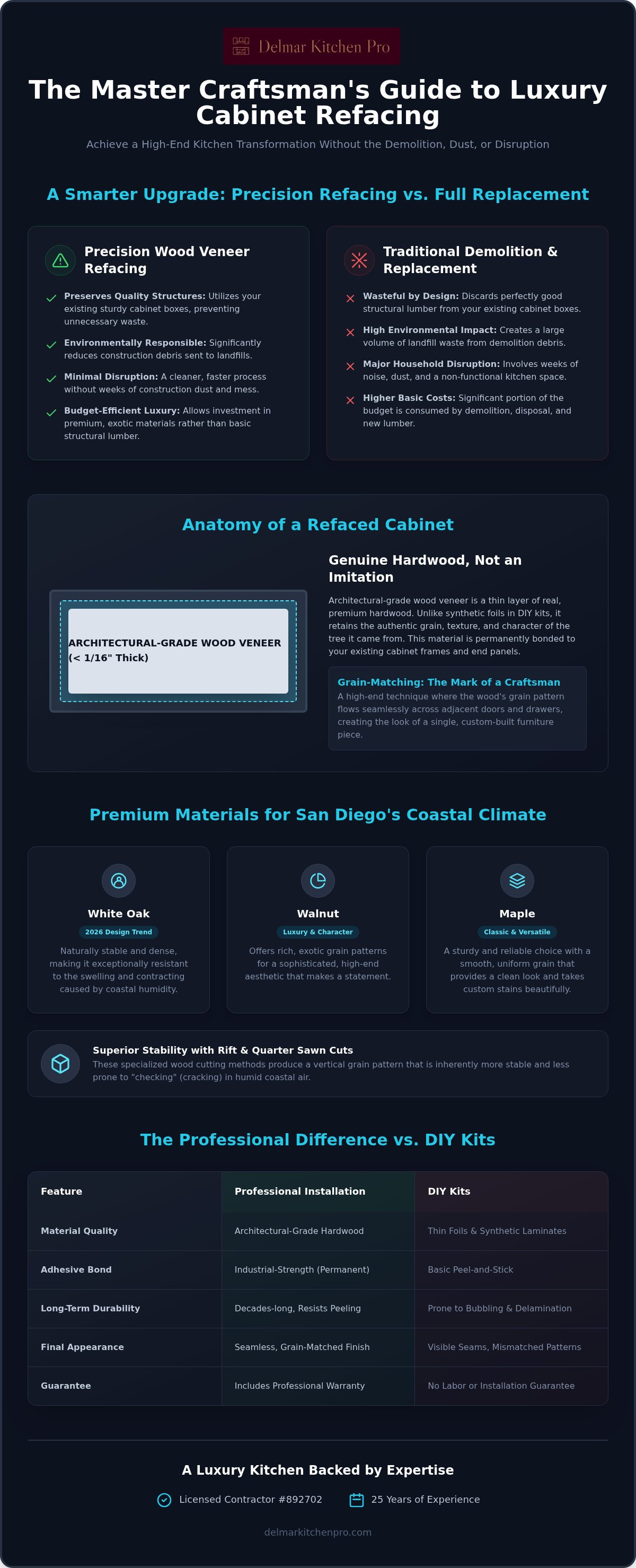
Wood veneer is a thin layer of genuine hardwood, typically less than 1/16th of an inch thick, that is permanently bonded to a structural surface. In the context of wood veneer cabinet refacing, this material isn't a synthetic imitation. It's a slice of natural timber that retains the unique grain, texture, and character of the tree it came from. Luxury refacing focuses on transforming the exterior of your kitchen while keeping the high-quality structural "bones" of your existing cabinetry intact.
The difference between a professional result and a standard update lies in the grade of the material. We use architectural-grade veneers, which are significantly more durable than the thin foils found in big-box DIY kits. These premium veneers allow for "grain-matching," a technique where the wood patterns flow seamlessly across multiple cabinet faces. This creates a cohesive, architectural statement that looks like a single piece of custom furniture rather than a collection of separate boxes. It's a methodical approach that prioritizes visual continuity.
The Anatomy of a Veneered Cabinet
A successful installation depends on the substrate, which is the surface the veneer sticks to. Most high-end cabinet boxes are made from plywood or high-density MDF. These materials are ideal because they provide a flat, stable surface that doesn't warp easily. During the process, we apply the veneer to two main areas: the face frames, which are the narrow front edges of the cabinets, and the end panels, which are the large visible sides. Once the boxes are wrapped, we install new custom-made doors and drawer fronts that match the veneer perfectly. This creates a unified, "like-new" appearance throughout the entire kitchen.
Refacing vs. Replacing: The Luxury Perspective
Many San Diego homeowners assume that a premium kitchen requires a total tear-out. However, if your current layout works and the cabinet boxes are sturdy, replacing them is often unnecessary. Preserving these structural elements is a hallmark of a master craftsman approach. It's a logical decision that allows you to invest your budget into superior materials, such as exotic Walnut or Rift Sawn White Oak, rather than spending it on basic structural lumber and demolition labor.
There's also an environmental benefit to this method. By choosing wood veneer cabinet refacing, you significantly reduce the amount of construction debris sent to local landfills. It's a responsible way to achieve a high-end aesthetic while minimizing the disruption to your home life. You get the visual impact of a custom kitchen without the mess or the waste of a full remodel. It's a smarter, cleaner way to build.
Selecting Premium Materials for San Diego Coastal Homes
Choosing materials for wood veneer cabinet refacing in San Diego requires more than just an eye for design. Coastal air carries moisture and salt, which can cause inferior materials to swell or delaminate if they aren't properly specified. We select wood species that offer natural stability and density. White Oak and Walnut are leading choices for 2026 trends because they handle environmental shifts with grace. Maple remains a sturdy, classic option for those seeking a smoother, more uniform grain that takes stain beautifully.
The decision between raw wood veneers and pre-finished luxury options often comes down to your desired level of customization. Pre-finished veneers offer a durable, factory-sealed surface that's ready for immediate use. Raw veneers, however, allow a master craftsman to apply custom stains and glazes that match your specific vision. Regardless of the choice, the goal is a "furniture grade" look where the grain patterns are matched across every cabinet face for a seamless visual flow.
Wood Species Performance in Coastal Climates
Homes in Encinitas or Del Mar face higher humidity levels than those further inland. This moisture can lead to "checking," which are small cracks that appear when wood expands and contracts too rapidly. To prevent this, we often recommend Rift Sawn or Quarter Sawn veneers. These specific cutting methods result in a vertical grain pattern that's inherently more stable than traditional flat-sawn wood. It's a technical detail that ensures your kitchen remains beautiful despite the constant sea breeze and shifting weather patterns.
Finishing Options: Stains, Glazes, and Protective Coatings
The Southern California sun is famous, but its intense UV rays can fade cabinetry over time. Luxury refacing utilizes high-performance, UV-resistant topcoats to preserve the wood's natural color and prevent yellowing. Many homeowners now opt for a "Luxury Modern" aesthetic, which favors matte or satin finishes over high-gloss options. These finishes reduce glare and hide fingerprints while highlighting the wood's tactile quality. If you want to see how these materials look in person, you can explore our curated selection of premium cabinet materials during a personalized consultation.
Achieving a high-end result with wood veneer cabinet refacing depends on the precision of the grain matching. We align the natural patterns of the timber so the grain flows vertically from the top cabinet down to the base unit. This creates a sense of intentionality and architectural symmetry. By focusing on these fine details, we transform standard cabinet boxes into custom pieces of art that reflect the unique character of your home.
Structural Integrity: Preparing Cabinet Boxes for Veneer
The longevity of wood veneer cabinet refacing depends entirely on the surface beneath the wood. You can't build a luxury kitchen on a failing foundation. Before a single sheet of veneer is cut, a thorough inspection of your existing cabinet boxes is mandatory. We look for structural squareness, load-bearing capacity, and the integrity of the original joinery. If the boxes are leaning or the frames are loose, these issues must be corrected first. A master craftsman ensures the shell is perfect before applying the skin.
Preparation is where most DIY projects fail. It's a methodical process that requires patience and the right tools. We don't just look at the surface; we evaluate the internal health of the wood. This ensures that the high-end architectural statement you're investing in remains stable for decades. Our 25 years of experience in the San Diego market has taught us that shortcutting the prep work always leads to delamination later. We do it right the first time.
Assessing Cabinet Box Health
Not every kitchen is a candidate for refacing. We look for specific red flags like water damage around the sink or wood rot in the base cabinets. These issues disqualify a box from the process because moisture compromises the adhesive's ability to hold. We also perform a "snap test" on the existing finish to check for bond strength. If the original paint or varnish is peeling, it must be completely removed. We often reinforce joints with pocket screws or industrial fasteners to ensure the cabinets can handle the weight of new, solid wood doors for the next twenty years.
The Professional Preparation Workflow
Cleaning and degreasing is the most critical step in the entire installation. Kitchens naturally accumulate a layer of vaporized cooking oils and waxes over time. These contaminants act as a barrier that prevents a permanent bond. We use industrial-grade solvents to strip these oils away safely. Once the surface is chemically clean, we move to mechanical preparation. This involves filling grain pits, nicks, and holes with high-performance wood filler to create a perfectly flat surface.
The final step in preparation is precision sanding. We use specific grit sequences to "scuff" the surface, creating a microscopic texture that allows the adhesive to grip. This mechanical bond is what prevents peeling or delamination in the future. We don't just sand for smoothness; we sand for adhesion. By the time we're finished, the cabinet boxes are leveled, squared, and perfectly primed for the wood veneer cabinet refacing process. This methodical preparation is why professional work stands the test of time while DIY attempts often fail within a few years.
The Installation Process: PSA vs. Contact Cement
The actual application of the wood veneer is where the "architectural skinning" happens. In professional wood veneer cabinet refacing, we choose between two primary bonding methods: Pressure Sensitive Adhesive (PSA) and traditional Contact Cement. PSA is a high-tech, peel-and-stick application that relies on intense, mechanical pressure to create a bond. It's a cleaner process and lacks the heavy fumes associated with older solvents. Contact cement, however, remains a preferred choice for high-heat areas near stoves or dishwashers. It creates a rigid, permanent bond that's incredibly resistant to temperature shifts. A master craftsman knows which adhesive suits the specific micro-climate of your kitchen.
Achieving a luxury finish requires more than just glue. We use specialized tools like J-rollers and veneer scrapers to apply hundreds of pounds of pressure per square inch. This step is non-negotiable for removing air pockets. We then use flush-trim routers and fine-tooth files to blend the veneer edges into the cabinet frame. Edge banding is the "make or break" detail of any luxury project. If the edges aren't handled with precision, the cabinet will look like a layered imitation. We scribe the veneers to the walls and adjacent surfaces to ensure a zero-gap finish that mimics solid wood construction.
Step-by-Step: The Master Craftsman’s Method
Our process starts with oversized cuts. We never cut veneer to the exact size of the cabinet face on a workbench. Instead, we apply a slightly larger piece and trim it on-site. This allows for a perfect fit even if the original boxes aren't perfectly square. We then apply uniform pressure across the entire surface using a methodical overlapping pattern. This is the secret to preventing the bubbling or peeling often seen in amateur work. Finally, we file the edges at a slight angle to create a smooth transition that's soft to the touch and visually seamless.
Common Installation Pitfalls to Avoid
One of the most frustrating issues in refacing is "telegraphing." This occurs when a single grain of dust or a small nick in the substrate is trapped under the veneer. Because the wood is so thin, that tiny particle will eventually show through as a visible bump. Adhesive failure is another common problem. Many DIY attempts peel within a year because the substrate wasn't properly degreased or the pressure applied was insufficient. We also pay close attention to grain direction. If the wood grain doesn't flow logically from one cabinet to the next, the entire kitchen aesthetic feels fractured and disorganized.
If you're ready to see how these professional techniques can transform your home, we invite you to learn more about our Cabinet Reface & Paint services. We focus on delivering a seamless, durable result that stands up to the demands of a busy San Diego household.
Why Professional Installation Trumps DIY Veneer Kits
While DIY kits are marketed as a quick weekend fix, they often fall short of the luxury standards required for a high-end San Diego home. These consumer-grade packages typically use thinner veneers and less reliable adhesives that can't withstand the daily rigors of a busy kitchen. Choosing professional wood veneer cabinet refacing ensures you're getting architectural-grade materials that simply aren't available in big-box stores. These premium materials are thicker, more stable, and allow for the deep, rich finishes that define a custom kitchen.
The most significant difference is the security of working with a Licensed Contractor (License #892702). A license represents more than just a legal requirement; it's a commitment to industry standards and long-term reliability. When a master craftsman handles your installation, the bond is designed to last 20 years or more. This longevity is backed by a professional warranty, providing peace of mind that a peel-and-stick kit can't offer. We take the logistical burden off your shoulders, managing every detail from material acclimation to the final hardware installation.
Precision Tools and Expert Eyes
Achieving a "factory finish" in a residential setting requires specialized industrial tools. DIY hand-tools often leave ragged edges or uneven seams that ruin the architectural aesthetic. We utilize high-precision flush-trim routers and specialized scrapers to ensure every corner is perfectly square and every seam is invisible. We do it right. With 25 years of experience, our team has the expert eyes needed to spot potential issues before they become permanent mistakes. We deliver a meticulous result without the dust, noise, and weeks of disruption associated with a full kitchen tear-out.
The Delmar Kitchen Pro Advantage
We've spent decades serving the high-end markets of La Jolla, Rancho Santa Fe, and greater San Diego. This local expertise means we understand how to design for the specific architectural styles and environmental conditions of our region. Our service goes beyond just the surface. We can seamlessly integrate new counter options or additional custom cabinets into your project for a comprehensive transformation. We focus on a steady, methodical workflow that respects your time and your home. If you're ready to elevate your space, you can transform your kitchen with professional refacing and achieve the architectural statement your home deserves.
Secure Your Kitchen’s Architectural Future
Professional wood veneer cabinet refacing is more than a cosmetic update; it's a precision-engineered transformation of your home's most important room. By selecting stable wood species and utilizing industrial-grade bonding techniques, you can achieve a luxury aesthetic that lasts decades. This methodical approach preserves your existing cabinet boxes while delivering a seamless, high-end finish that respects both your budget and your environment.
We've spent 25 years perfecting this craft as a Licensed Contractor (#892702) in San Diego. Our team focuses on the fine details that ensure durability in coastal climates like La Jolla, Del Mar, and Rancho Santa Fe. You don't have to navigate a messy, months-long remodel to get the kitchen of your dreams. We're here to guide you through a stress-free process that prioritizes quality and transparency. Your home deserves the care of a master craftsman. We look forward to helping you create a space that feels both new and timeless.
Request Your Luxury Kitchen Consultation in San Diego
Frequently Asked Questions
How long does professional cabinet veneer installation typically take?
A professional installation usually takes between three and five days to complete on-site. This timeline is significantly shorter than a full kitchen remodel, which can often stretch into several weeks. The process begins with meticulous preparation of your existing cabinet boxes, followed by the application of the veneer and the installation of new custom doors. Most San Diego homeowners find they can still use their kitchen during the evenings throughout the project.
Will the veneer peel off if it gets wet or is near the stove?
Professional-grade veneers will not peel when installed with industrial adhesives like high-heat contact cement. Unlike consumer-grade DIY kits, our process utilizes bonding agents specifically designed to withstand the moisture and temperature shifts common near ovens and dishwashers. As a licensed contractor with 25 years of experience, we ensure that every edge is sealed and every surface is pressurized to prevent delamination, even in humid coastal environments like Del Mar.
Can you install wood veneer over painted or finished cabinets?
Yes, we can apply veneer over existing finishes provided the substrate is structurally sound. The key to success is our rigorous preparation workflow. We strip away old oils, waxes, and loose paint using industrial solvents before sanding the surface to create a mechanical bond. If the original finish is peeling or unstable, we remove it entirely. This ensures the wood veneer cabinet refacing has a perfectly clean, flat foundation for a permanent bond.
Is cabinet veneer as durable as solid wood for daily kitchen use?
Veneer is often more durable and stable than solid wood in the variable humidity of San Diego. Solid wood tends to expand and contract, which can lead to warping or cracking over time. Because architectural veneer is bonded to a stable plywood or MDF core, it resists these environmental shifts while providing the exact visual and tactile experience of genuine hardwood. It's a high-performance solution designed for the rigors of a heavy-use luxury kitchen.
What is the difference between cabinet refacing and resurfacing?
Refacing is a comprehensive upgrade where we wrap the existing cabinet boxes in real wood veneer and replace all doors and drawer fronts with new, custom-made components. Resurfacing is a broader, often less intensive term that may refer only to painting or refinishing existing surfaces. Refacing provides a structural and aesthetic transformation that is indistinguishable from brand-new custom cabinetry, offering a much higher level of durability and a "like-new" architectural statement.
How do I clean and maintain my new veneered cabinets?
You should maintain your veneered cabinets exactly like high-quality solid wood furniture. We recommend using a soft, damp microfiber cloth with a drop of mild dish soap for daily cleaning. It's important to avoid abrasive pads or harsh chemical cleaners that could degrade the protective UV-resistant topcoat. Wiping up spills immediately and dusting regularly will preserve the luster of the wood grain and keep your kitchen looking pristine for decades to come.
Can I change the wood species of my cabinets through veneering?
Changing the wood species is one of the greatest advantages of wood veneer cabinet refacing. You can transform outdated honey oak cabinets into modern Rift Sawn White Oak, rich Walnut, or clean Maple without replacing the structural boxes. Because we wrap every visible inch of the cabinet frames in new architectural-grade wood, the original species is completely hidden. This allows you to completely redefine your kitchen’s style to match current luxury design trends.
Does cabinet refacing increase the resale value of my San Diego home?
Refacing is a high-impact investment that typically offers a return of 70% to 80% of the project cost upon resale. In competitive markets like La Jolla and Rancho Santa Fe, a modern, high-end kitchen is a primary selling point for prospective buyers. By achieving a luxury aesthetic without the high price tag and long timeline of a full demolition, you maximize your home's value while minimizing the initial capital required for the upgrade.


