

What if a damaged or dated granite counter doesn’t need to be replaced? A chip or crack may call for a closer look, while a pattern or layout that no longer suits your kitchen could point to a larger update. The right granite countertop replacement decision starts with the counter’s condition and how you use the room every day.
It’s understandable to want clear answers before committing to a project. You need to know whether repair or replacement makes sense, which countertop material and details will work with your kitchen, and how installation may affect your routine. Careful planning can make those decisions easier and help prevent avoidable surprises.
This guide explains signs that may warrant replacement, factors to weigh when comparing countertop options, and details to discuss with a contractor. You’ll also learn what to confirm before measurements and installation, and how to coordinate the new counter with cabinetry and the wider kitchen design.
Key Takeaways
- Visible chips or stains don’t automatically mean the whole counter needs replacing; the extent and pattern of damage matter.
- Decide whether granite countertop replacement makes sense by weighing the damage, the look you want, and your plans for the kitchen.
- Compare countertop options around appearance, daily care, kitchen use, and how they work with your cabinets and backsplash.
- Plan the project in order, from discussing goals and assessing the kitchen to confirming materials, measuring, and coordinating installation.
- Consider Delmar Kitchen Pro’s countertop options alongside cabinet services and custom kitchen construction, backed by more than 25 years of experience.
Granite Countertop Replacement: When Is It Time for a Change?
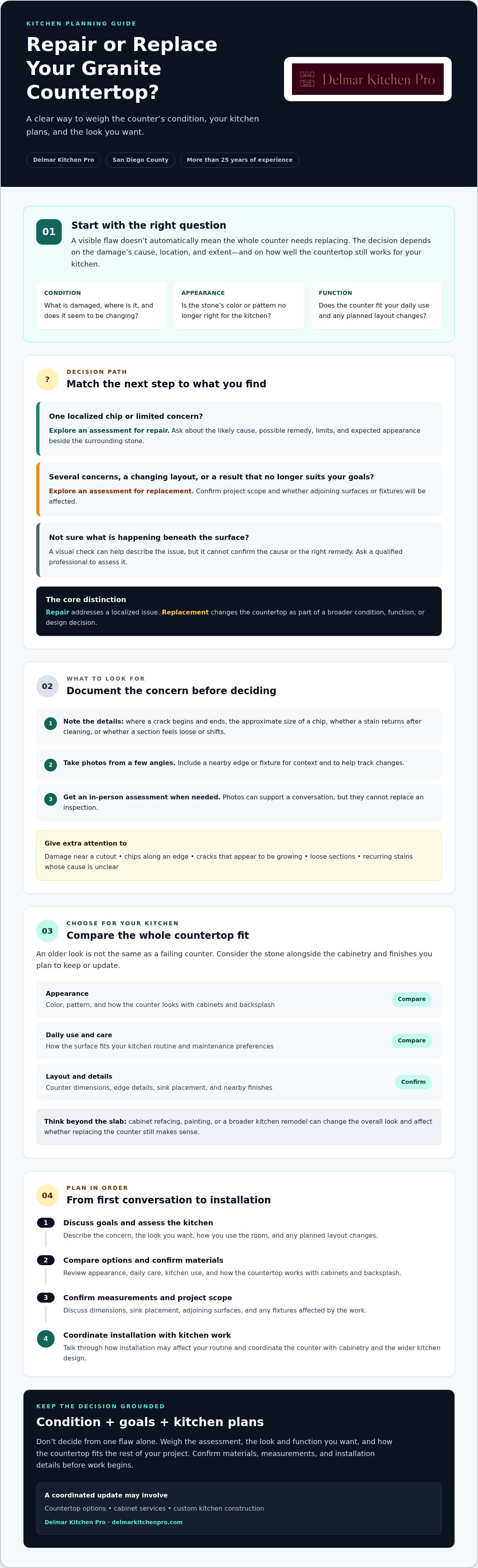
A chip, stain, or visible crack can make you wonder whether the entire countertop has to go. Not necessarily. The next step depends on the damage’s cause, location, and extent, along with how well the counter still serves your kitchen. A visual check can help you describe the issue, but it can’t confirm what’s happening beneath the surface or determine the right remedy.
Separate appearance from condition and function. You may dislike the color or pattern but find the counter works well. Or you may be planning a new kitchen layout that calls for different counter dimensions, even if the existing stone is intact. Granite is a natural material with variation in its formation and composition; the geological properties of granite offer useful background on why slabs can differ.
Which granite countertop problems deserve a closer look?
Document what you see before making a decision. Note where a crack begins and ends, the approximate size of a chip, whether a stain returns after cleaning, and whether any section seems loose or shifts. Take photos from a few angles and include a nearby edge or fixture for context. They can help track changes and support a conversation, but they can’t replace an in-person assessment.
Details matter. Damage near a cutout, a chip along an edge, a crack that appears to be growing, or a loose section may need closer evaluation. Recurring stains also deserve attention, particularly if you’re unsure whether they’re on the surface or linked to another issue. Don’t assume a repair will work, or that replacement is necessary, based on one sign alone. Ask a qualified professional to assess the counter when the cause or extent of a problem isn’t clear.
Does a dated kitchen mean the granite has to go?
An older look isn’t the same as a failing counter. A small, busy pattern or a short matching backsplash may feel dated beside the cabinets, but that’s a design concern, not proof the stone needs replacing. Consider how the counter looks with the cabinetry and finishes you plan to keep or update. Cabinet refacing, painting, or a broader kitchen remodel could change the overall look and affect whether replacing the counter still makes sense.
Function is a separate question. If the counter no longer fits a planned layout or doesn’t meet the way you use the kitchen, replacement may be worth considering even without obvious damage. Replacement merits consideration when the counter’s condition, appearance, or fit with the kitchen’s needs can’t be resolved within the project you have planned.
Repair or Granite Countertop Replacement: How to Choose
A full replacement can be unnecessary work if the problem is limited and a suitable repair can meet your needs. But repair may not address widespread damage, a changed kitchen layout, or a countertop you no longer want. The choice depends on what an inspection finds and what result you’re aiming for, not on one visible flaw alone.
Use this comparison to prepare questions for a qualified professional. These are options to explore, not guaranteed outcomes.
| Situation | Option to explore | What to confirm |
|---|---|---|
| One localized chip or other limited concern | Assessment for repair | Likely cause, remedy, and expected appearance |
| Several concerns or a result that no longer suits your goals | Assessment for replacement | Full project scope and adjoining surfaces or fixtures affected |
| Countertop dimensions may change with a new layout | Replacement planning | Measurements, sink placement, and coordination with the kitchen work |
When might repair be worth exploring first?
If the concern appears limited to one area, request an assessment before assuming the whole counter must go. Ask the professional to explain the likely cause, available remedies, and their limits, including how the result may look beside the surrounding stone. Then weigh that expected result against your priorities: a functional surface, a consistent appearance, or a particular design change.
When does replacement better fit the project?
Replacement may fit better when concerns extend across the counter, the layout is changing, or the countertop is part of a coordinated kitchen renovation. It can also be a chance to reconsider edge details, sink placement, and finishes next to the counter. Confirm during the assessment whether adjoining surfaces or fixtures affect the work. The appropriate choice depends on the inspection, project scope, and materials confirmed for the project.
The core distinction is simple: repair addresses a localized issue, while replacement changes the countertop as part of a broader condition, function, or design decision. Replacing a counter that could be repaired may add work without delivering a result you need. Before deciding, ask how each option aligns with your kitchen plans and what else may be affected. The industry standards for dimension stone provide technical reference material that can support informed project discussions.
If the counter decision is part of a wider kitchen update, explore how custom kitchen and countertop options may be considered together.
Choose a Countertop That Fits Your Kitchen and Daily Use
A successful granite countertop replacement should suit more than the room’s color palette. It should work with your daily routines, cabinet finishes, backsplash, and planned layout. Delmar Kitchen Pro offers countertop options, but specific materials should be confirmed before making a direct comparison. Ask which options are currently available, then evaluate them using the same practical criteria.
How should you compare countertop materials?
Look beyond a sample’s first impression. Ask how each confirmed option fits your expected kitchen use and what routine care it requires. Find out which edge details are possible and whether the selected material can accommodate the planned sink and layout. Don’t rely on broad claims about stain resistance, heat resistance, maintenance, or lifespan without information specific to the material and its care requirements.
Natural stone can vary in pattern and appearance. If samples or slab viewing are available, compare them with the actual cabinet and backsplash finishes rather than judging them alone. Check the surface in your kitchen’s lighting, too. The Natural Stone Institute’s Dimension Stone Design Manual is a technical reference for stone design and construction; your project professional can help explain which details apply to your selection.
- Appearance: Does the pattern and overall tone feel balanced with the room?
- Care: What regular care does the supplier recommend for this specific option?
- Use: Does the material fit the way your household prepares food and uses the counter?
- Details: Which edge profiles, sink placement, and adjoining finishes can be coordinated with it?
How do cabinets, backsplash, and layout affect the choice?
Judge the countertop alongside the elements that will remain. Cabinet color, backsplash, flooring, and lighting all affect how a surface reads. A sample that looks calm in a showroom may feel busier against a patterned backsplash, while a darker counter can change the room’s visual balance. If cabinets are being refaced or painted, choose finishes with the counter in mind rather than treating each decision separately.
Confirm the layout before measurements are finalized. A change to an island, sink position, or counter run can affect dimensions and coordination. If the existing layout is staying, make that clear during planning; if it may change, settle that first. Delmar Kitchen Pro’s cabinet services and custom kitchen construction can help homeowners consider countertop choices as part of a coordinated kitchen update.
Plan Granite Countertop Replacement in San Diego County
A well-planned granite countertop replacement follows a clear order, but the details depend on your kitchen and project scope. Site conditions, selected materials, and any cabinet or layout changes can affect how work is sequenced. Don’t rely on a fixed timeline before those details are reviewed. Homeowners in San Diego, Encinitas, Del Mar, La Jolla, and Rancho Santa Fe should also confirm service availability for their specific location.
- Discuss your goals. Identify what you want to change, what you plan to keep, and how you use the kitchen.
- Assess the existing kitchen. Review the counter, cabinets, sink area, and adjoining finishes, and note any planned changes.
- Confirm materials and details. Verify current options, then document the selected material, edge details, and sink or fixture plans.
- Measure the project. Confirm who verifies dimensions and when measurements will be finalized.
- Coordinate the work. Agree on installation sequencing, access, protection, and the responsibilities of everyone involved.
What should happen before final measurements?
Settle the cabinet layout and sink and fixture plans first. A change to any of these can affect the counter dimensions or cutouts. Ask who takes and verifies the final measurements, and how the selected material and agreed details will be recorded. Confirm what adjacent work is included in the project scope, such as cabinet changes or backsplash work, and which tasks may require separate trade coordination.
What should homeowners ask before installation?
Discuss practical arrangements before work begins. Clear answers help you prepare the room and understand who is responsible for each task.
- How will the work area and nearby cabinets or flooring be protected?
- What access is needed to bring materials into the kitchen?
- Who handles removal and disposal of the existing counter?
- How will installation be sequenced with sink or plumbing coordination and any adjoining work?
- What cleanup is included, and who manages each task?
Ask for a written scope that states the selected material, measurements and details, included work, responsibilities, and any items excluded. If plumbing, disposal, or other work is handled separately, clarify who coordinates it and when. This keeps expectations clear without assuming every project follows the same sequence.
For homeowners considering a countertop update alongside cabinet services or broader kitchen construction, discuss your kitchen project with Delmar Kitchen Pro. Confirm the scope and local availability directly before making plans.
Work With Delmar Kitchen Pro on a Coordinated Countertop Update
A granite countertop replacement may be one part of a larger kitchen project, especially if you’re also considering cabinet changes or a different layout. Delmar Kitchen Pro provides countertop options, cabinet services, and custom kitchen construction. Coordinating these decisions in one project discussion can help clarify how the counter relates to the cabinetry and other planned work. It doesn’t mean every homeowner needs a full remodel; the right scope depends on your goals and the existing kitchen.
Delmar Kitchen Pro brings more than 25 years of industry experience and is privately owned and operated by a licensed contractor, License #892702. Those facts can help establish who you’re speaking with, but the project still needs a clear, specific plan. Confirm which countertop materials are currently available, what work is included, and whether the company’s service coverage includes your location.
What can a coordinated kitchen project help clarify?
Countertop choices connect to cabinet dimensions, sink placement, and the finishes around the work area. If cabinetry or the layout is changing, discussing those decisions together can help clarify the order of work, which measurements depend on other choices, and who is responsible for each task. Ask for the agreed scope in writing, including any work that is excluded or requires separate coordination. A connected plan supports clear expectations, but it doesn’t guarantee a particular outcome or make every project simpler.
What information should you bring to a first conversation?
Start with useful details about the kitchen as it is now and what you want it to become. A few clear photos can help frame the discussion, though they don’t replace an in-person assessment when one is needed.
- Photos of the countertop, cabinets, sink area, and any visible damage.
- A short list of what you want to keep, change, or coordinate with other kitchen work.
- Questions about local service coverage and which counter options are currently available.
- Questions about assessment steps, project responsibilities, and what the written scope will cover.
Use the conversation to understand whether the proposed scope fits your needs. If you’re still comparing repair, replacement, or a broader kitchen update, say so. A measured discussion can help identify what needs to be confirmed before you make a decision.
To discuss your plans and ask about countertop options, talk with Delmar Kitchen Pro about your countertop project.
Make Your Countertop Decision With Confidence
The right granite countertop replacement starts with an honest look at the counter’s condition and your plans for the kitchen. Localized damage may call for an assessment before you decide on full replacement. If you do replace the counter, weigh appearance, daily use, and how the material will work with your cabinets, backsplash, and layout.
Clear planning matters, too. Confirm material options, measurements, what the project includes, and who coordinates adjoining work before installation begins. These details help you compare options and set practical expectations.
Delmar Kitchen Pro brings more than 25 years of industry experience to custom kitchen construction, cabinet services, and countertop options. The business is privately owned and operated by a licensed contractor, License #892702. If you’re considering a counter update, talk with Delmar Kitchen Pro about your countertop project and discuss your goals, existing kitchen, and project scope.
A careful decision, made with the whole kitchen in mind, can help you move forward with greater clarity and confidence.
Frequently Asked Questions
Can granite countertops be repaired instead of replaced?
Yes, repair may be worth exploring when the damage appears limited, but an in-person assessment is needed to determine possible remedies. A professional can consider the damage’s location, cause, and extent, then explain the likely result and any limits. Compare that expected result with your goals for function and appearance. Don’t assume a chip or crack always requires a new counter, or that every issue can be repaired.
How do I know when granite countertop replacement is necessary?
Granite countertop replacement may be worth considering if the counter has widespread concerns, no longer suits your kitchen’s use, or won’t fit a planned layout change. A dated appearance alone doesn’t mean the granite must go. First, assess the counter’s condition and how it relates to your renovation plans. If the cause or extent of damage is uncertain, ask a qualified professional to inspect it before choosing a remedy.
Can you replace granite countertops without replacing the cabinets?
Often, a countertop project can be considered separately from cabinet replacement, but the existing cabinets and project conditions need to be assessed. Their layout, condition, and compatibility with the planned counter can affect measurements and installation planning. Tell the contractor which cabinets you intend to keep, and ask whether any cabinet work is needed, who handles it, and how the counter installation will be coordinated with the existing kitchen.
What countertop materials can replace granite?
Available alternatives depend on the materials offered for your project, so confirm the current selection before comparing specific options. Ask to review samples where available and compare appearance, expected routine care, suitability for your kitchen use, and how each option works with your cabinets and backsplash. Also discuss edge details, sink plans, and any layout changes. Delmar Kitchen Pro offers counter options, but specific material availability should be confirmed directly.
How long does granite countertop replacement take?
There isn’t one reliable timeline for every project. The schedule can depend on the kitchen’s existing conditions, selected material, measurements, project scope, and coordination with cabinetry or other work. Ask the contractor to explain the expected sequence and identify which details could affect scheduling. Before making plans around the work, request a project-specific schedule and ask how you’ll be informed if site conditions or selections change the sequence.
What should I expect during countertop removal and installation?
Expect the project team to review access, protection, removal, installation sequence, and cleanup before work begins. Confirm who is responsible for removing and disposing of the old counter, protecting nearby cabinets and flooring, and coordinating any sink or plumbing work. Ask what must be cleared from the kitchen and what is included in the written scope. The exact process depends on the home and project, so clarify responsibilities in advance.
Does Delmar Kitchen Pro serve San Diego, Encinitas, and nearby communities?
Delmar Kitchen Pro focuses on San Diego and nearby communities, including Encinitas, Del Mar, La Jolla, and Rancho Santa Fe. Confirm current service coverage for your specific address before planning a project. The company provides custom kitchen construction, cabinet services, and countertop options, but available materials and project scope should also be discussed directly. Sharing your location and the work you’re considering can help clarify whether the project is a fit.


