

What if the right kitchen cabinet door style depends as much on your daily routine as on the look you love? Shaker, slab, and raised-panel doors can be hard to tell apart at first, but their profiles shape a room’s character and affect how much detail you’ll need to clean. Choosing among kitchen cabinet door styles is easier when you compare each profile’s appearance, upkeep, and fit with your home.
You may already know whether you prefer a clean, modern face or a more traditional, detailed look. The next step is understanding how that choice affects maintenance and whether the style fits your existing cabinetry. This guide compares popular door profiles and offers practical ways to narrow your options.
You’ll also learn when painting or refacing may suit your kitchen and when a broader cabinetry update deserves consideration. With a clearer picture of your priorities, you can plan how the doors, cabinets, and overall kitchen design will work together.
Key Takeaways
- Kitchen cabinet door styles are defined by their visible profile, not by cabinet construction, finish, color, or hardware.
- Learn how Shaker, slab, raised-panel, inset, beadboard, and glass-front doors create different visual effects.
- Use a door’s grooves and edge details to anticipate cleaning needs and decide what suits your household.
- Compare reference images to find shared details and narrow your shortlist to profiles that suit your room.
- Consider how cabinet doors, finishes, hardware, and counters work together when planning a cohesive kitchen update.
Kitchen Cabinet Door Styles: What Changes When You Change the Profile?
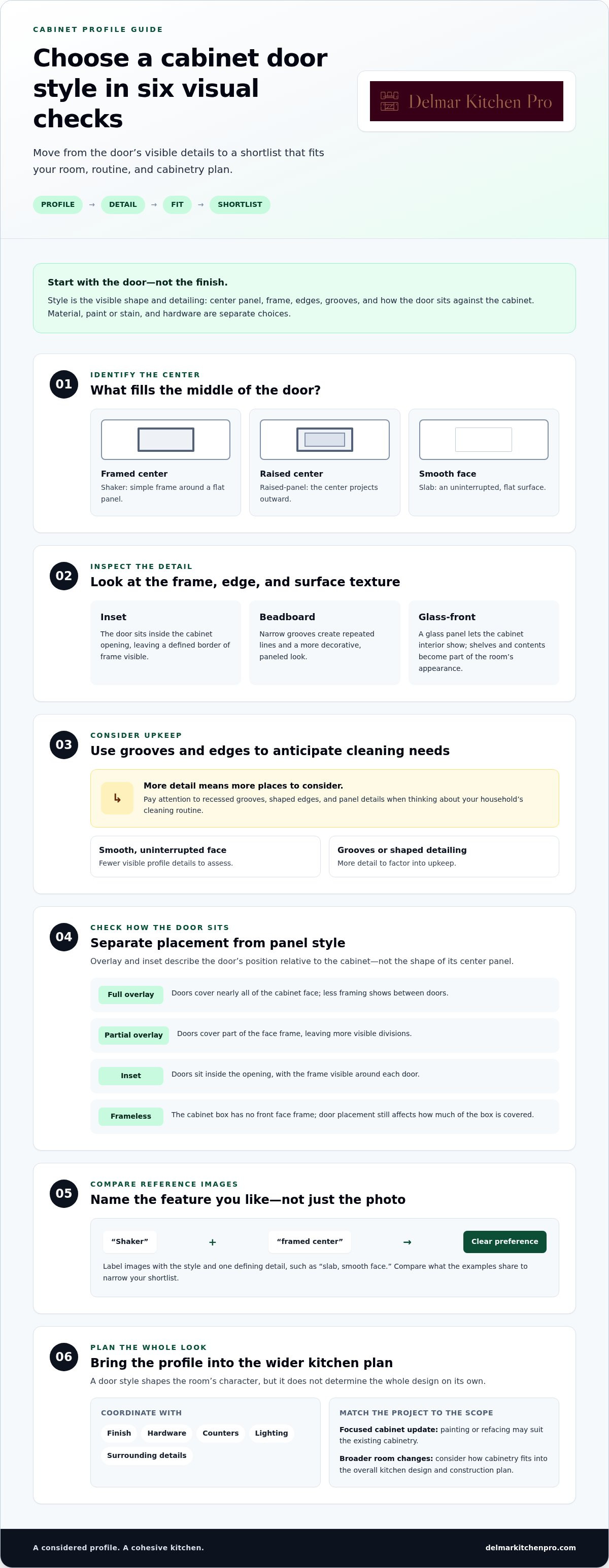
A cabinet door style is the visible shape and detailing of the door, including its center panel, surrounding frame, edges, and any grooves or decorative shaping. How the door sits against the cabinet also affects the finished look. Together, these elements create the profile you see across the kitchen, from a plain, uninterrupted face to one with more depth and detail.
Keep the profile separate from other cabinet choices. Wood species describes the material; paint or stain describes the finish and color; hardware describes the knobs or pulls. The same profile can be made in different materials and finished in different colors. For background on cabinet structure and common materials, see this overview of the Kitchen cabinet.
The profile influences a room’s visual character, but it doesn’t determine whether the whole kitchen feels traditional, modern, or somewhere between. Finish, hardware, counters, lighting, and surrounding details all contribute. A well-planned design considers these elements together rather than treating the door style as a complete room plan.
What makes one cabinet door style different from another?
Start with the center. It may be a flat panel, a raised panel, glass, or another inset detail. Then look at the frame: is it broad or narrow, plain or shaped? The edge may be square or softened, while grooves and trim add further definition. These details distinguish profiles even when doors share the same color or material.
How do overlay and inset doors relate to style?
Overlay and inset describe how a door sits in relation to the cabinet opening or face frame, not the shape of its center panel. The amount of cabinet framing left visible changes the pattern across the kitchen. Neither arrangement is universally better. The right fit depends on the appearance you want and the cabinetry plan.
| Term | What it means | Visual effect |
|---|---|---|
| Full overlay | Doors cover nearly all of the cabinet face or face frame. | Less framing shows between doors, creating a more continuous front. |
| Partial overlay | Doors cover part of the face frame, leaving more of it visible. | Visible frame creates stronger divisions between doors and drawers. |
| Inset | Doors sit inside the cabinet opening, aligned within the face frame. | The frame remains visible around each door. |
| Frameless | The cabinet box has no front face frame; doors attach to the box. | There’s no face frame between doors, though the door placement still affects how much of the box is covered. |
Overlay choices generally apply to face-frame cabinetry, while frameless describes the cabinet’s construction. Keep those terms distinct when comparing options. For a wider view of how cabinetry fits into the room, explore this luxury kitchen design guidance. Delmar Kitchen Pro’s kitchen design, construction, and cabinet refacing or painting can bring a door update into line with the existing cabinetry and the overall plan.
Popular Kitchen Cabinet Door Styles, From Shaker to Slab
Door-style names are easier to remember when you can picture the profile. Use this quick visual guide to compare defining details, then look at samples or photos to see how those profiles read across a full kitchen. Bob Vila’s overview of kitchen cabinet door styles offers another reference for identifying common door components and profiles.
How do Shaker, raised-panel, and flat-panel doors look?
- Shaker: A flat center panel sits inside a simple, four-sided frame. The restrained detailing gives the door visible structure without elaborate carving.
- Raised-panel: The center panel projects outward from the surrounding frame, often with shaped or beveled edges. That relief creates more depth and shadow than a flat center.
- Flat-panel or slab: The door has a smooth, uninterrupted face, with no framed center panel. Its simple surface puts more visual focus on the finish, color, and hardware.
When do inset, beadboard, or glass-front doors make sense?
- Inset: The door sits inside the cabinet opening, leaving the surrounding frame visible. This creates a defined border around each door and drawer front.
- Beadboard: Narrow grooves run along the center panel, adding repeated lines and texture. The detail gives the cabinet front a more decorative, paneled appearance.
- Glass-front: A glass panel replaces some or all of the solid center, allowing the cabinet interior to show. Use it selectively for items you want on display. Shelves and their contents become part of the room’s appearance, so everyday organization matters.
These labels describe visible features, but they don’t dictate a single material or finish. A framed profile can have a painted surface or visible wood grain, while a slab face can be made in different materials. For a useful side-by-side reference, label each image with the style name and one defining feature, such as “Shaker, framed center” or “slab, smooth face.” Comparing those details helps you describe what you like rather than simply point to a photo.
For an existing kitchen, cabinet refacing or painting can update the look while keeping the project focused on the cabinetry. A broader kitchen design and construction plan can coordinate door profiles with the rest of the room. Delmar Kitchen Pro’s kitchen design and construction brings cabinetry choices into the wider plan.
Compare Cabinet Door Styles by Cleaning, Character, and Project Fit
The practical difference between profiles often shows up in their edges and recesses. A smooth door gives dust and cooking residue fewer places to settle, while grooves and shaped details may take more attention during routine cleaning. Use this comparison as a starting point, not a durability ranking. Material, finish, installation, and care guidance for the specific door also matter.
| Profile | Detail | Visual effect | Cleaning considerations | Project context |
|---|---|---|---|---|
| Flat-panel or slab | Smooth, uninterrupted face | Simple, clean-lined appearance | Broad surfaces are generally straightforward to wipe; follow finish care guidance. | Can suit a plan focused on uncluttered lines or a quieter cabinet face. |
| Shaker | Flat center panel framed by rails and stiles | Defined structure with restrained detail | The inner corners and frame edges may need extra attention. | Useful when you want visible framing without elaborate shaping. |
| Raised-panel | Center panel projects from the frame | More depth and shadow across the door | Shaped edges and transitions can collect residue and call for careful wiping. | Consider it where a more detailed cabinet face fits the surrounding room. |
| Beadboard | Narrow grooves across the panel | Repeating lines add texture | Grooves may need a cloth or soft brush to clean thoroughly. | Works when added texture supports the room’s intended character. |
| Glass-front | Glass panel reveals the cabinet interior | Creates a display area and visual openness | Both glass and visible shelves need regular attention. | Often best used selectively for items you’re comfortable displaying. |
Which cabinet door styles are easiest to clean?
Smooth faces are often simpler to wipe than doors with grooves, recessed corners, or shaped edges. Daily upkeep also depends on how the kitchen is used. Frequent cooking, splashes near a cooktop, and busy household routines can affect how often cabinet fronts need attention. Choose cleaning products and methods according to the finish and manufacturer’s care instructions. Don’t assume every painted, stained, or laminated surface should be treated the same way.
How should style fit the home and renovation scope?
Look beyond the cabinet sample. Compare the door with nearby trim, flooring, counters, and the atmosphere you want the room to have. Homes in San Diego, Encinitas, Rancho Santa Fe, La Jolla, and Del Mar vary in architecture and interior details, so location alone doesn’t point to one suitable profile. Decide whether the change is limited to existing cabinetry or part of a broader kitchen update.
Material and profile work together: visible wood grain can emphasize the shape of a framed door, while a painted finish can make its lines read more quietly. For more on pairing wood and cabinetry choices, see this custom wood kitchen cabinet guidance. A considered plan matches the door, finish, and project scope to the room without assuming one style is best for every home.
Choose a Kitchen Cabinet Door Style in Five Practical Steps
A clear selection process keeps visual preferences and renovation scope from getting tangled. Use these five steps to move from inspiration to a decision you can explain to a kitchen professional.
- Define the goal. Decide what you want the update to change. You might want a quieter look, more visible detail, a lighter feel, or a refreshed appearance without changing the kitchen’s layout.
- Assess the room. Note the existing cabinet condition and the details that will stay, such as flooring, counters, trim, and lighting. The door should feel connected to the room rather than chosen in isolation.
- Shortlist profiles. Collect a small set of reference images. For each one, note the door profile, finish, color, hardware, and nearby materials. Group the images by shared features, such as a framed center panel or a smooth face, instead of relying on style labels alone.
- Compare upkeep. Consider how often you cook, where splashes tend to land, and how much detail you’re comfortable cleaning. Grooves and shaped edges may call for more careful wiping than a smooth surface. Compare finish samples in your kitchen’s actual light, since daylight and evening lighting can change how colors and textures appear.
- Confirm project scope. Separate the look you want from the work needed to achieve it. A visual refresh may involve painting or refacing existing cabinetry. Changes to cabinet layout or construction may call for a broader kitchen project.
How can you turn inspiration images into a clear shortlist?
Look for repeated details across your saved examples. If several images share simple framed doors, similar hardware, and understated finishes, those common elements may matter more to you than the style name. Bring a few representative images and material notes into the planning process. They give your kitchen professional a practical starting point for matching the look to the room and cabinetry.
Should you reface, paint, or replace cabinets?
The right route depends on the condition of the existing cabinets and how much you want to change. Painting or refacing can update appearance; neither is the same as changing the room’s layout or rebuilding cabinetry. Delmar Kitchen Pro provides cabinet refacing and painting alongside kitchen construction, so the project plan can reflect your goal. Read this cabinet refacing guidance for more context on that option.
Use Delmar Kitchen Pro’s kitchen design and construction information as a reference while shaping your cabinet update plan.
Bring Your Chosen Cabinet Door Style Into a Cohesive Kitchen
A door profile works best as part of a considered whole. Its shape, finish, and hardware should relate to the counters, flooring, lighting, and other details that will stay in the room. For example, a simple door with understated pulls creates a different effect than the same profile paired with prominent hardware and strongly patterned counters. Neither is automatically right; the goal is a combination that feels intentional and suits how you use the kitchen.
Think about the balance of color and texture, too. A painted cabinet finish can make door details read clearly, while visible wood grain brings its own pattern to the surface. Hardware adds another layer, and counters can either complement the cabinetry or provide contrast. Looking at these choices together helps turn a favorite among kitchen cabinet door styles into a plan for the entire space.
How does Delmar Kitchen Pro help plan a cohesive cabinet update?
Delmar Kitchen Pro’s luxury kitchen design and construction work brings cabinetry into the broader room plan. Cabinet options and countertop choices can be considered alongside the door profile, finish, hardware, and surrounding details. For an existing kitchen, cabinet refacing or painting can change the cabinetry’s appearance; a larger construction project can address broader changes to the kitchen. With over 25 years of industry experience, Delmar Kitchen Pro plans these decisions as connected parts of one project and carries the design through construction and installation.
What should you bring to a kitchen style consultation?
A little preparation makes it easier to explain what you want and what needs to change. Bring:
- Photos of the current kitchen, including cabinet fronts, counters, flooring, and nearby trim.
- A small collection of inspiration images, with notes on the door details, colors, finishes, and hardware you like.
- A short list of what works well now and what feels dated, inconvenient, or out of place.
These notes help distinguish a style preference from a project requirement. You may love a door’s profile but want to keep the existing layout, or you may be planning a wider update that brings cabinetry and counters together. Homeowners in San Diego, Encinitas, Rancho Santa Fe, La Jolla, and Del Mar can review Delmar Kitchen Pro’s kitchen services as they plan their project.
Make Your Cabinet Choice Part of a Thoughtful Kitchen Plan
The right kitchen cabinet door styles balance the look you want with the way you use your kitchen. Compare profiles by their visible details and cleaning needs, then consider how each option works with your finishes, hardware, counters, and room. Keep the style decision separate from project scope, too. Painting or refacing can refresh existing cabinetry, while changes to layout or construction call for broader planning.
A cohesive update comes together through careful choices, not a single door profile. Delmar Kitchen Pro brings over 25 years of industry experience to luxury kitchen design and construction, cabinet refacing and painting, and cabinet and countertop planning. Homeowners in San Diego, Encinitas, Rancho Santa Fe, La Jolla, and Del Mar can consider cabinet options as part of the wider kitchen plan.
To turn your ideas into a clear plan, explore Delmar Kitchen Pro’s kitchen services. Start with the details you love and the changes you need to make.
Frequently Asked Questions
What are the most popular kitchen cabinet door styles?
Shaker, flat-panel or slab, and raised-panel doors are familiar choices, each with a distinct profile. Shaker has a framed center panel, slab has a smooth face, and raised-panel doors have a center that projects outward. Beadboard and glass-front doors add texture or display space. Compare actual samples or clear photos, since the profile, finish, and hardware together shape the cabinet’s appearance.
Which kitchen cabinet door style is easiest to clean?
Flat-panel doors are often simplest to wipe because their faces have fewer grooves and recesses. Shaker frames, raised edges, and beadboard grooves can need more careful attention, especially near cooking areas where splashes and residue occur. Glass-front doors also require cleaning the glass and keeping visible shelves orderly. Upkeep depends on the finish and the manufacturer’s care guidance, so check those instructions before choosing cleaning products.
Are Shaker cabinet doors still in style in 2026?
Yes. Shaker remains a popular choice in 2026, in part because its framed center panel has clear definition without elaborate ornament. A 2026 analysis of more than 60 cabinet-focused booths at the Kitchen & Bath Industry Show found Shaker doors in half of the kitchens observed. Its simple profile can suit different room plans, but the finish, hardware, and surrounding details determine the final effect.
What is the difference between Shaker and raised-panel cabinet doors?
Shaker doors have a flat center panel set within a simple frame. Raised-panel doors have a center panel that projects outward, often with shaped edges that create more depth and shadow. From across the room, Shaker generally reads as more restrained, while raised panels make the door face more detailed. Both profiles can be paired with different finishes, so compare samples with your kitchen’s other materials.
Can you change cabinet door style without replacing the cabinets?
Often, yes. If the existing cabinetry suits the project, replacing or refacing its doors can change the visible style while keeping the cabinet layout. Painting can also refresh the appearance without changing the profile. The right approach depends on the condition of the cabinets and whether you want a visual update or changes to layout and construction. Delmar Kitchen Pro provides cabinet refacing and painting as well as kitchen construction.
Are inset cabinet doors more expensive than overlay doors?
Inset doors can involve more precise fitting because each door sits within the cabinet opening, with the surrounding frame visible. Overlay doors cover some or most of the cabinet face, depending on the overlay. The overall project scope, cabinetry, and selected materials all affect cost, so there isn’t one price comparison that applies to every kitchen. Consider the desired appearance alongside how the doors fit the existing or planned cabinetry.
How do I choose cabinet door styles for a San Diego home?
Choose based on your home’s existing details and how you want the kitchen to feel, not on location alone. Compare door samples with your counters, flooring, trim, and lighting, and consider cleaning needs alongside appearance. Homes in San Diego, Encinitas, Rancho Santa Fe, La Jolla, and Del Mar vary in architecture and interior character. Room photos and a few inspiration images can help clarify what belongs in your plan.


