

By the end of 2026, the landscape for San Diego kitchen design will look remarkably different as new California safety regulations reshape how we handle engineered stone. You've likely spent months searching for the perfect slab to serve as the centerpiece of your home. It's a significant investment, and you deserve a result that reflects that value. Understanding luxury countertop installation standards is the best way to ensure your stone isn't marred by visible seams, uneven surfaces, or structural issues that could have been avoided with better care.
We understand that the technical side of a kitchen remodel can feel overwhelming. This guide provides you with a clear checklist of benchmarks to hold your contractor to. You'll learn the secrets of precision bookmatching, the importance of proper sub-top leveling, and how to navigate the shift toward quartzite and porcelain as silica rules change. By the end, you'll have the confidence to oversee a project that meets the highest levels of craftsmanship and ensures your kitchen lasts for decades.
Key Takeaways
- Learn how to evaluate your project against professional luxury countertop installation standards to ensure aesthetic perfection and long-term durability.
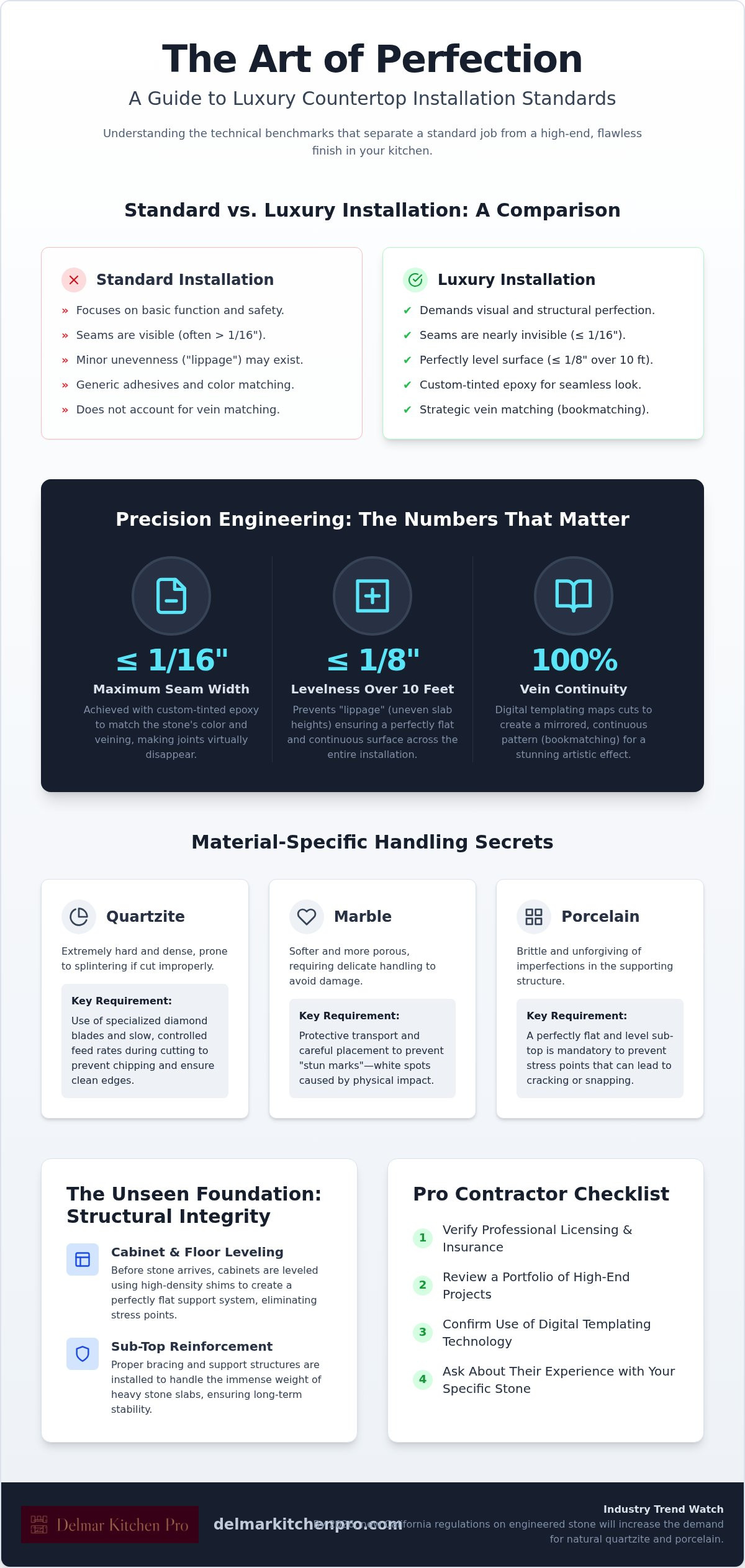
- Identify the technical requirements for "invisible" seams, including the 1/16th of an inch width limit and the use of custom-tinted epoxy.
- Understand the structural benchmarks for cabinet reinforcement and sub-top bracing needed to support heavy stone slabs safely.
- Discover material-specific handling secrets, such as specialized cutting tools for quartzite and protective transport methods for delicate marble.
- Get a clear checklist for vetting local San Diego contractors by verifying professional licensing and reviewing high-end craftsmanship portfolios.
Defining the Luxury Countertop Installation Standard
Luxury isn't just a label for expensive stone. It's a technical commitment to precision. While a basic Countertop installation focuses on providing a surface that stays in place, luxury countertop installation standards demand visual and structural perfection. Organizations like the Natural Stone Institute (NSI) provide the industry's baseline benchmarks. These rules ensure slabs are safe and stable. However, a standard install often fails to meet the expectations of a high-end San Diego home. A luxury finish requires much tighter tolerances and a deeper understanding of material physics.
Working with heavy, expensive slabs involves significant risk. This is why hiring a licensed contractor like Delmar Kitchen Pro (License #892702) is vital. With 25 years of experience, we know that a single mistake during the move or the cut can ruin a five-figure investment. We don't just follow the rules. We exceed them to protect your home and your vision. A true luxury installation is defined by what you don't see: the hidden supports, the perfectly level base, and the microscopic seams.
The Aesthetic vs. Technical Divide
Technical standards are the foundation. They ensure your stone doesn't crack under its own weight or shift over time. Aesthetic standards are the finish. They ensure the stone looks like a single, continuous piece of art rather than several disconnected slabs. In San Diego's coastal environments, humidity and temperature can affect how materials behave. We balance these needs by using reinforced sub-tops and precision leveling that accounts for the specific architecture of your kitchen. If the cabinets aren't perfectly level, the stone will eventually stress and crack. We fix those issues before the stone even arrives.
Why High-End Materials Require Specialized Handling
Every material has a unique personality. Exotic quartzite is stunning but incredibly hard. It's prone to splintering if the contractor doesn't use specialized diamond blades and slow feed rates. Marble is much softer. It requires delicate handling to prevent "stun marks," which are white spots caused by physical impact during transport. Large-format porcelain presents its own challenges, specifically regarding thermal expansion. It's a brittle material that needs a perfectly flat bed to prevent snapping. If a contractor treats these materials like standard granite, the results are often disastrous. High-end surfaces deserve a master craftsman who understands these specific nuances.
Precision Engineering: Seams, Leveling, and Tolerances
Precision in stonework isn't a suggestion; it's a requirement for high-end results. When we implement luxury countertop installation standards, we're talking about tolerances that most installers ignore. Following the guidelines in the Dimension Stone Design Manual, a professional installation must ensure that seams are nearly invisible to the naked eye. This means keeping joint widths to 1/16th of an inch or less. We achieve this by using custom-tinted epoxies that match the base color and the secondary mineral veins of your specific slab. A seam should be felt as a smooth transition, never as a gap or a ridge.
Leveling is the silent hero of a successful project. We maintain a strict variance of no more than 1/8 inch over a 10-foot span. This prevents "lippage," where one piece of stone sits higher than the piece next to it. These microscopic adjustments ensure that your kitchen island feels like a single, massive piece of stone rather than a collection of parts. If you're planning a luxury custom kitchen, these technical details ensure your investment stands the test of time and looks flawless under any lighting.
Vein Continuity and Bookmatching
Bookmatching is the process of joining two slabs so they mirror each other, creating a dramatic, continuous pattern. For materials like Calacatta marble or deeply veined quartzite, this is a non-negotiable standard. We use digital templating software to map out these cuts before any blades touch the stone. This allows you to see exactly how the veins will meet at the seams. Seam placement becomes a strategic design choice rather than a logistical necessity. We aim to hide the joint within the natural movement of the stone's pattern.
The Science of Leveling
A slab is only as good as the cabinets beneath it. We verify that the floor and cabinet runs are level before the stone arrives. If the cabinets are out of alignment, we use high-density shims to create a perfectly flat support system. This prevents stress points that lead to future cracking. Plane-level for luxury installations means a perfectly flat, horizontal surface that maintains consistent height across all joined segments without any detectable lippage. These luxury countertop installation standards protect the stone from the structural shifts common in San Diego homes.
Material-Specific Installation Requirements
Luxury surfaces aren't interchangeable. Each slab has a unique physical composition that dictates how it must be cut, handled, and set. Adhering to Natural Stone Institute installation standards ensures that the specific mineral properties of your stone are respected during every phase of the project. For instance, quartzite is currently one of the most sought-after materials, but it's also the hardest natural stone available. It requires specialized diamond blades and constant water cooling to prevent the stone from shattering during fabrication. Standard granite tools simply won't suffice for a high-end quartzite project.
Marble requires a different level of care. It's softer and prone to "stun marks" if bumped during transport or installation. These white impact marks are permanent and ruin the aesthetic of a premium slab. Meanwhile, engineered quartz requires careful management of resin-pooling, which can create unsightly dark spots in the pattern if the fabrication isn't precise. As we move into 2026, large-format porcelain slabs are becoming the new standard for ultra-thin, sleek luxury. Porcelain is incredibly durable but remains brittle until it's fully supported; it requires a master craftsman's touch to prevent snapping during the setting process.
Natural Stone Density and Porosity
Managing porosity is essential for long-term beauty. High-end marble and granite need professional-grade sealing to resist staining from oils and acids. In coastal areas like Del Mar and La Jolla, the salt air can be a factor in material longevity. We use penetrating sealers that bond at a molecular level to protect the stone's integrity. We also prioritize mitered edges for a seamless, thick-slab look. A mitered edge involves cutting the stone at a 45-degree angle so the pattern wraps perfectly around the side. It's a hallmark of luxury countertop installation standards that separates professional work from a basic remodel.
Engineered Stone Modern Standards
Engineered materials have their own set of rules. For long unsupported spans, like a breakfast bar, we follow strict minimum thickness requirements to prevent bowing or structural failure. Many homeowners worry about the "plastic" look sometimes associated with quartz. We solve this through high-end edge detailing and custom polishing that mimics the depth of natural stone. UV stability is another critical factor. San Diego kitchens often have large windows with high sun exposure. We select materials and adhesives that won't yellow or fade when exposed to intense afternoon light. This level of planning ensures your kitchen stays vibrant for decades.
Structural Integrity: Preparation and Bracing
A luxury kitchen is built from the ground up. High-end stone slabs are remarkably heavy, often weighing between 20 and 30 pounds per square foot. Without proper reinforcement, even the most durable quartzite can cause cabinets to bow or joints to fail. Adhering to luxury countertop installation standards means performing a structural audit before the stone ever leaves the warehouse. We often install sub-top layers of marine-grade plywood or cement board. This provides a flat, rigid surface that distributes the weight of the stone across the entire cabinet box, preventing localized stress points that lead to fractures.
Modern design favors clean lines and open spaces. This often includes large islands with significant overhangs for seating. To achieve the popular "floating" look safely, we utilize hidden steel brackets. These invisible supports are routed into the top of the cabinet or sub-top, providing the necessary tensile strength without the need for bulky, decorative corbels. This is the hallmark of invisible engineering in a luxury custom kitchen. It ensures the stone remains stable while maintaining the minimalist aesthetic you expect from a high-end remodel.
The Foundation: Cabinet Leveling
In older San Diego estates, particularly in La Jolla or Del Mar, structural settling is a common reality. A countertop is only as stable as the cabinets beneath it. If the base isn't perfectly true, the stone will eventually crack at its weakest point. Delmar Kitchen Pro performs a comprehensive pre-installation audit to identify and correct these issues. We ensure the base is plumb and level, adjusting for years of natural home movement before we commit to the final set. This step is non-negotiable for any project aiming for long-term durability.
Supporting the Modern Island
Cantilevered designs require strict adherence to physics. As a general rule, any overhang exceeding 10 to 12 inches requires additional structural support to prevent tipping or snapping. For a seamless look, we integrate these supports within the cabinetry or the mitered joints of a waterfall edge. A waterfall edge isn't just a visual statement; it's a complex structural miter that must be engineered to handle the vertical load of the stone. By following these luxury countertop installation standards, we ensure your island remains a safe and stunning focal point for decades. We balance the weight of the material with the grace of the design.
Selecting a Luxury Countertop Partner in San Diego
Choosing the right partner for your project is the final, most critical step in achieving a flawless finish. In the San Diego market, the difference between a standard install and a masterpiece lies in the details. You need a contractor who doesn't just "place" stone but understands the complex physics of luxury countertop installation standards. This process starts with verifying credentials. Always look for a valid California Contractor License, such as Delmar Kitchen Pro’s License #892702. A licensed professional provides the accountability and insurance coverage necessary to protect your home during a high-value remodel.
Reviewing local portfolios is equally important. Look for completed projects in high-end neighborhoods like Encinitas, Rancho Santa Fe, and La Jolla. These areas often feature the complex architectural requirements and exotic materials that test a craftsman's true skill. A comprehensive design-to-build partner will manage every detail, from the initial structural audit of your cabinets to the final application of professional-grade sealants. By 2026, the industry standard for luxury service includes not just the installation, but a clear roadmap for long-term maintenance and multi-year warranties that give you total peace of mind.
Vetting Your San Diego Contractor
When you interview potential installers, ask specific questions about their technology and methodology. Do they use digital laser templating to ensure a perfect fit against your walls? Will they provide a digital preview of the vein alignment before they cut into your slabs? Request to see close-up photos of their seam work and bookmatching. A true master craftsman takes pride in showing how they hide joints within the natural movement of the stone. Ensure the team you hire handles the full structural integration, including any necessary cabinet reinforcement or hidden steel bracing discussed earlier. You want a single point of contact who takes full responsibility for the project's success.
The Delmar Kitchen Pro Standard
Our 25 years of industry experience in San Diego informs every decision we make. We understand the local climate, the coastal material requirements, and the expectations of homeowners who demand excellence. We operate with a sense of moral clarity and transparency, providing direct answers and grounded advice. We aren't just installers; we are your dedicated partners in creating a space that lasts for decades. We follow luxury countertop installation standards because we believe your investment deserves nothing less than precision. Schedule your luxury kitchen consultation today to begin your journey toward a kitchen that balances strength with timeless beauty.
Build Your Vision on a Foundation of Precision
Your kitchen is more than a workspace; it's the heart of your home and a significant investment in your lifestyle. Achieving a flawless finish requires a strict adherence to luxury countertop installation standards. This involves everything from the "invisible" engineering of hidden steel supports to the meticulous color-matching of microscopic seams. These technical benchmarks ensure your stone remains a stunning centerpiece for decades rather than just a few years.
Success depends on the expertise of your chosen partner. Delmar Kitchen Pro brings over 25 years of local San Diego experience to every project. As a licensed California contractor (#892702), we specialize in high-end material integration and structural integrity. We manage the complex logistics so you can focus on the beauty of your new space. Our commitment to transparency ensures you always know exactly what to expect during your remodel.
Start Your Luxury Kitchen Transformation with Delmar Kitchen Pro. We're ready to help you create a kitchen that reflects your high standards and provides lasting peace of mind.
Frequently Asked Questions
What is the maximum allowable width for a countertop seam in a luxury kitchen?
The maximum allowable width for a countertop seam in a high-end kitchen is 1/16th of an inch. Following luxury countertop installation standards, a seam should be virtually invisible and smooth to the touch. We use custom-tinted epoxies that match the specific color and mineral patterns of your slab. This level of precision is what separates a master installation from a standard one. If a seam is wider or uneven, it indicates poor leveling or cutting.
Do I need extra support for a granite island with a large overhang?
You absolutely need extra support for any granite or quartzite overhang that exceeds 10 to 12 inches. Heavy stone slabs can easily snap or tip if they aren't properly braced. In San Diego homes, we typically use hidden steel brackets routed into the sub-top to maintain a clean, floating look. This avoids the need for bulky corbels while ensuring the safety and structural integrity of your kitchen island for decades.
What is bookmatching and is it necessary for all stone types?
Bookmatching is the process of joining two slabs so they mirror each other, creating a continuous, symmetrical pattern. It's essential for materials with heavy veining, like Calacatta marble or exotic quartzite, where pattern flow is the main design feature. It isn't necessary for uniform stones like absolute black granite or solid-colored quartz. We use digital templating to ensure the veins align perfectly at the seams, which is a hallmark of premium craftsmanship.
How do I know if my cabinets are strong enough for heavy quartzite counters?
Your cabinets must be able to support between 20 and 30 pounds per square foot to handle heavy stone. We perform a structural audit of your cabinetry before the installation begins. In older estates in La Jolla or Rancho Santa Fe, we often find that cabinets need reinforcement or leveling to prevent the stone from cracking later. We ensure the base is plumb and true so the weight is distributed evenly across the frame.
Is it normal to see a seam in a marble countertop?
It's normal for a marble countertop to have a seam, but it should never be an eyesore. In a luxury installation, the goal is to make the joint as inconspicuous as possible. We achieve this through precise vein matching and the use of specialized adhesives tinted to blend with the stone's unique palette. When luxury countertop installation standards are met, the seam feels like a smooth, natural part of the slab's surface rather than a visible gap.
How long does a professional luxury countertop installation typically take?
A professional luxury installation typically takes one to three days on-site. This doesn't include the time for digital templating and off-site fabrication, which can take several weeks. The physical installation involves setting the slabs, leveling the joints, and applying final sealants. Because we prioritize precision over speed, we take the necessary time to ensure every bracket is secure and every mitered edge is perfectly aligned before we consider the job finished.
Should I seal my natural stone countertops immediately after installation?
Yes, you should seal natural stone countertops immediately. Our team applies a high-grade penetrating sealer during the final phase of the installation process. This is especially important in coastal San Diego environments like Del Mar, where salt air and humidity can affect porous materials. A professional sealant bonds with the stone at a molecular level. It provides a vital barrier against oils, acids, and water that could otherwise cause permanent staining or etching.
What is the difference between a mitered edge and a standard edge?
A mitered edge involves cutting the slab at a 45-degree angle so the pattern wraps around the side, creating the look of a much thicker slab. A standard edge is simply a polished profile on the side of a 2cm or 3cm piece of stone. The mitered edge is considered the luxury standard because it hides the joint and allows for a seamless pattern flow. It requires significant skill and specialized equipment to execute correctly.


