

A luxury kitchen transformation in 2026 no longer requires a six-figure demolition or a compromise on material integrity. You might believe that achieving a magazine-quality aesthetic necessitates tearing out your entire layout, but the reality of modern craftsmanship proves otherwise. It's common to feel stuck between the frustration of outdated cabinet styles and the staggering expense of a full remodel. This is especially true for homeowners in San Diego who worry about how coastal humidity might impact the longevity of their investment.
We agree that your home deserves a finish that is as durable as it is beautiful. By refacing kitchen cabinets with wood or exploring the high-tech resilience of modern thermofoil, you can secure a factory-perfect look without the typical construction stress. This guide provides a direct comparison of these premium materials to help you choose the best fit for your lifestyle. We'll examine the bespoke character of natural grains, the moisture-proof benefits of engineered surfaces, and how to achieve a high return on investment while maintaining the highest standards of quality.
Key Takeaways
- Learn why refacing is the smart 2026 choice for high-end kitchens, offering a luxury update with significantly less construction waste than a full replacement.
- Discover the bespoke appeal of refacing kitchen cabinets with wood to achieve the rich textures and deep stains only natural maple, cherry, or walnut can provide.
- Understand why modern Rigid Thermofoil (RTF) serves as a technically superior moisture barrier for coastal homes in communities like Encinitas and Rancho Santa Fe.
- Compare the scratch resistance and structural hardness of natural wood against the seamless, engineered durability of modern vacuum-sealed vinyl finishes.
- See how working with a licensed master craftsman ensures a factory-perfect finish and protects your home’s value through precision installation techniques.
What is Cabinet Refacing? The Smart Luxury Choice
Many homeowners assume a high-end kitchen transformation requires a total demolition. This isn't the case in 2026. When people ask What is Cabinet Refacing? they are discovering a process that preserves structurally sound cabinet boxes while replacing every visible surface. This approach is the cornerstone of sustainable luxury. It reduces construction waste by keeping high-quality materials out of local landfills while delivering a factory-perfect finish. You get the aesthetic of a brand-new kitchen without the environmental or logistical cost of a full tear-out.
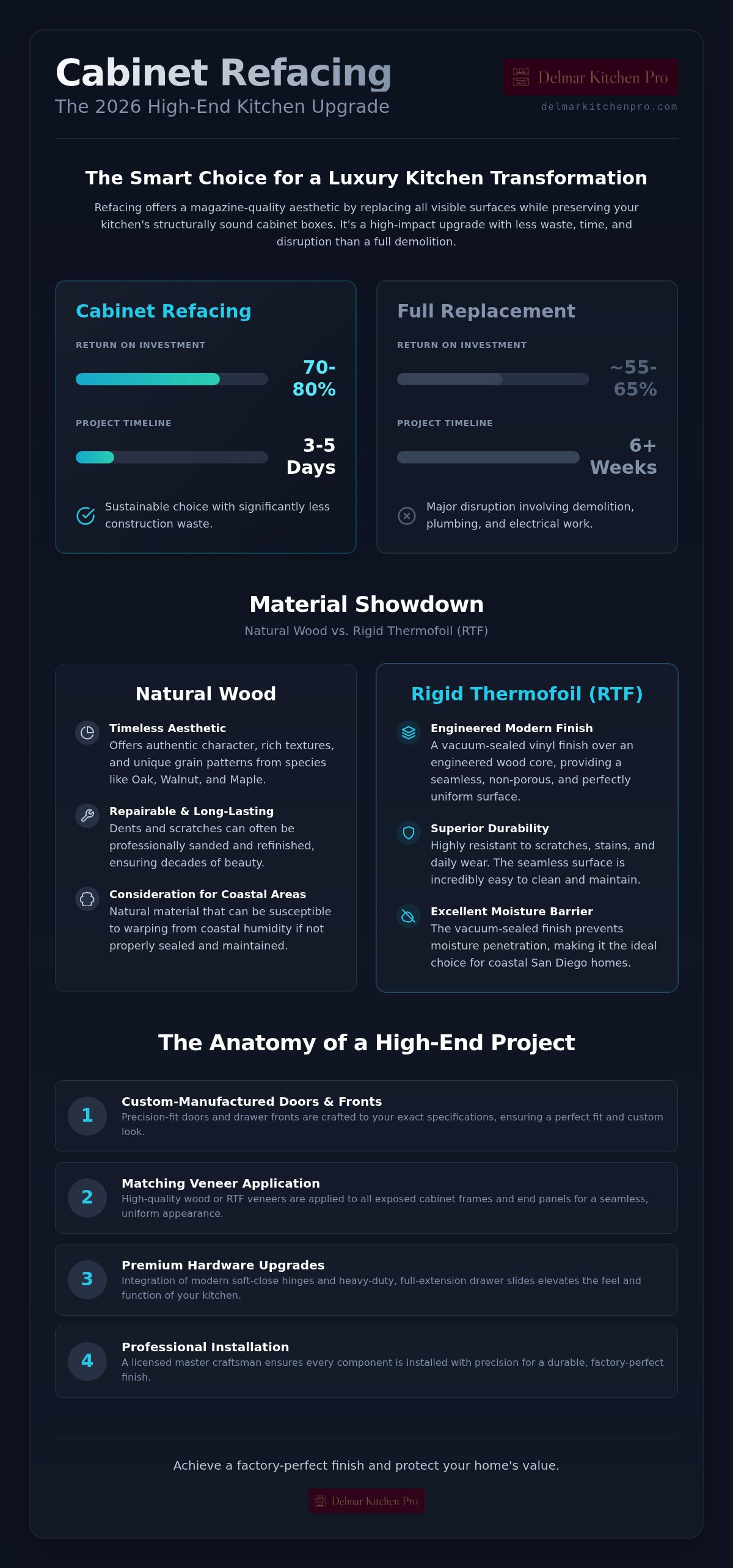
We start every project with a rigorous audit of your existing frames. Not every kitchen is a candidate for this process. If your current cabinet boxes are level and made of solid plywood or furniture-grade materials, they provide an excellent foundation. Refacing kitchen cabinets with wood allows you to keep your functional layout while completely changing the visual character of the room. You achieve a custom-built look without the typical six-week timeline of a full gut remodel. Most professional projects are completed in just three to five days.
The Anatomy of a High-End Refacing Project
A professional transformation involves more than just swapping doors. We manufacture custom doors and drawer fronts specifically for your kitchen's dimensions. We then apply matching veneers to the face frames and end panels for a seamless transition. This process includes:
- Custom-Manufactured Doors: Precision-fit panels tailored to your specific style and layout.
- Matching Veneers: High-quality skins applied to all exposed cabinet surfaces to ensure a uniform appearance.
- Hardware Upgrades: Integration of modern soft-close hinges and heavy-duty drawer slides for a premium feel.
Refacing vs. Replacing: The ROI Perspective
Homeowners in San Diego often choose this route because it balances speed with a high return on investment. Industry data suggests that refacing can recoup approximately 70% to 80% of its cost when you sell your home. By preserving your existing layout, you avoid the high costs of plumbing and electrical relocation. This allows you to allocate your budget toward premium counter options or professional-grade appliances. It's a strategic move that delivers a luxury result with less disruption to your daily life. Refacing kitchen cabinets with wood ensures that your investment focuses on the visual and tactile quality of the materials rather than the hidden costs of demolition.
Refacing Kitchen Cabinets with Wood: Timeless Elegance
Natural wood provides a depth of character that defines high-end interiors. While Cabinet refacing costs vary based on the species selected, the investment in natural materials offers unmatched longevity. Refacing kitchen cabinets with wood is a preferred choice for those who value the tactile warmth and unique grain patterns of cherry, maple, or walnut. Wood is inherently repairable. If a door is scratched or dented over years of use, it can often be sanded and touched up by a professional. This repairability ensures your kitchen remains pristine for decades, unlike synthetic alternatives that may require full replacement if damaged. In San Diego home designs, particularly in traditional or transitional estates, the authenticity of real wood grain creates an atmosphere of grounded luxury that feels both established and contemporary.
Selecting the Right Wood Species
Choosing the right material is a critical step in the design phase. Maple and Birch are exceptional choices if you desire a smooth, uniform finish that resembles high-end paint but retains the structural integrity of solid wood. These species lack heavy graining, making them ideal for a clean, minimalist look. White Oak has emerged as the 2026 favorite for coastal modern homes in Encinitas and Del Mar. Its open grain and neutral tones perfectly complement organic aesthetics and light-filled spaces. For those seeking mid-century modern sophistication in La Jolla, Walnut offers a rich, dark palette that serves as a focal point in any project involving refacing kitchen cabinets with wood.
The Craftsmanship of Wood Veneering
The secret to a factory-perfect finish lies in the application of real wood veneers. We use a high-pressure bonding process to ensure a permanent, bubble-free seal on your existing cabinet frames. This is not a simple adhesive. It is a structural layer that matches your new doors exactly. We meticulously align grain patterns across cabinet faces to create a high-end furniture feel throughout the space. This attention to detail prevents the visual breaks that can occur in lower-quality installations. Professional staining ensures color consistency across different wood lots, even when working with naturally varied species. If you are ready to see how these materials look in your space, our team can guide you through a luxury cabinet reface and paint consultation to find your perfect match.
The Modern Alternative: Rigid Thermofoil (RTF) Engineering
Rigid Thermofoil, often called RTF, represents the pinnacle of engineered cabinetry surfaces. It's a seamless vinyl wrap applied over a medium-density fiberboard core using intense heat and vacuum pressure. This industrial process creates a monolithic surface with no visible joints or seams. In coastal environments like San Diego, this engineering offers a distinct advantage. While refacing kitchen cabinets with wood provides a classic look, wood is naturally porous and reacts to salt air and humidity. RTF acts as a complete moisture barrier. It won't swell, warp, or crack when exposed to the damp coastal breeze. It's a high-performance choice for those who prioritize technical resilience.
Many homeowners still associate this material with the delaminated cabinets of decades past. We're here to eliminate the "peel" myth once and for all. By 2026, industrial adhesives and vacuum-press technology have reached a level of permanent bonding that was previously impossible. Modern RTF uses high-performance, cross-linking glues that create an unbreakable union between the wrap and the core. Beyond its durability, RTF is exceptionally hygienic. The non-porous nature of the surface means there are no microscopic crevices where bacteria, mold, or kitchen grease can settle. It's one of the easiest materials to sanitize, ensuring your food preparation areas stay truly clean.
Achieving the 'Perfect' Finish
One of the primary draws of RTF is its absolute consistency. You won't find brush strokes, knots, or unpredictable grain variations here. Every door is identical in color and texture. This is especially valuable for larger kitchens where uniformity is a requirement for a luxury aesthetic. New ultra-matte technology has introduced "soft-touch" finishes that feel like silk under your fingertips while actively resisting smudges. If you prefer the ultra-modern European look popular in Del Mar, high-gloss slab doors offer a reflective, glass-like finish that makes any space feel larger. While refacing kitchen cabinets with wood focuses on natural variation, RTF focuses on engineered perfection.
Heat Resistance and Safety Standards
Modern RTF is rated for high-traffic and high-heat environments. We install specialized, low-profile heat shields next to ovens and dishwashers to protect the finish from concentrated thermal exposure. This professional step ensures your cabinets remain as pristine as the day they were installed. Maintaining this material is remarkably simple. You won't need specialized oils, waxes, or wood conditioners. A damp microfiber cloth is usually all you'll ever need to keep the surfaces looking factory-new. While refacing kitchen cabinets with wood requires periodic maintenance to protect the finish, RTF is a "set it and forget it" solution for the busy homeowner who values both time and quality.
Wood vs. Thermofoil: The San Diego Homeowner’s Comparison
Choosing between natural materials and engineered surfaces involves balancing aesthetic character with technical performance. When refacing kitchen cabinets with wood, you are investing in the organic hardness of species like maple or cherry. These materials are remarkably durable but can be susceptible to surface scratches over time. In contrast, modern vinyl wraps used in thermofoil are designed specifically for high surface resilience. While you can't sand a scratch out of thermofoil like you can with wood, the surface is significantly harder to mar in a high-traffic environment. The decision often rests on whether you prefer the living character of natural materials or the unwavering perfection of an engineered finish.
Maintenance requirements differ greatly between the two. Wood requires periodic attention to protect its finish from drying out or becoming brittle. If you choose refacing kitchen cabinets with wood, you gain the ability to sand and refinish the surfaces decades later. This gives wood a lifecycle that can span generations. Thermofoil offers a different kind of value through its wipe-down ease. It doesn't require specialized conditioners or oils. For many homeowners, the choice comes down to the long-term commitment they want to make to their kitchen’s upkeep.
Coastal Living Considerations
San Diego’s unique microclimates play a major role in material selection. In areas like Rancho Santa Fe or Encinitas, salt air and humidity can cause natural wood to expand and contract. This movement can lead to small cracks in paint or joints over several years. Modern thermofoil provides a completely sealed barrier that is impervious to these environmental shifts. Additionally, 2026 UV-resistance ratings for white thermofoil ensure the color stays crisp and bright. Natural wood can yellow when exposed to the intense California sun. For properties directly on the beach, our master craftsman recommendation often leans toward thermofoil to ensure the longest possible aesthetic lifespan without environmental degradation.
2026 Style Trends: Wood Grains and Matte Solids
Design trends for 2026 are moving toward textured luxury. Modern thermofoil can now mimic the look and feel of rift-sawn oak with incredible accuracy, providing the visual warmth of wood with superior durability. The Greige movement continues to dominate, with warm neutrals looking particularly sophisticated in matte thermofoil finishes. We often see homeowners choose a two-tone approach. This involves using a natural wood accent on a kitchen island while keeping the perimeter wall cabinets in a durable, matte thermofoil. This combination provides the best of both worlds: tactile beauty and engineered resilience. If you are ready to explore these combinations, we invite you to view our work with a luxury custom kitchen transformation.
Professional Execution: The Delmar Kitchen Pro Standard
Luxury results depend on the person behind the tools. Choosing a licensed contractor like Delmar Kitchen Pro (License #892702) protects your investment and your home. This license ensures that every material application and structural adjustment meets California's strict building standards. For over 25 years, we've brought "firm handshake" reliability to every San Diego project. We believe in moral clarity and transparent communication. You will always know exactly what to expect during your remodel. Our 25-year legacy is built on delivering high-level results with meticulous care.
The hallmark of our craftsmanship is the 'Invisible Edge' technique. When refacing kitchen cabinets with wood, many homeowners worry about visible seams where the veneer meets the frame. Our specialized application method ensures that your cabinet boxes look like solid pieces of furniture. We eliminate raw edges and ensure a seamless transition between surfaces. This level of precision is what creates a factory-perfect luxury finish. Our process is designed for minimal disruption to your daily life. We complete most projects in just three to five days. You don't have to endure a six-week gut remodel to get the kitchen of your dreams.
Customizing Your Transformation
A high-end refacing project often serves as the foundation for a complete aesthetic update. We can integrate new counter options or build custom cabinetry to improve your kitchen's layout while we reface your existing frames. Hardware selection is another critical step in the process. We help you select handles and pulls that elevate your chosen material from standard to luxury. These small details provide the tactile feedback of quality every time you open a drawer. Every project concludes with a rigorous final inspection. We check every hinge and alignment to ensure the work meets our Master Craftsman standards.
Ready to Transform Your Kitchen?
Deciding between the bespoke character of natural grains and the engineered perfection of thermofoil is easier with an expert guide. We provide on-site consultations to evaluate your existing cabinet boxes and discuss which material best suits your lifestyle. Whether you are refacing kitchen cabinets with wood in Rancho Santa Fe or choosing moisture-proof RTF for a beach-front home in Del Mar, we are here to help. We are proud to serve our neighbors in Encinitas, Del Mar, and La Jolla with dependable, professional service. Schedule your professional refacing consultation with Delmar Kitchen Pro today.
Secure Your Luxury Kitchen Transformation
Refacing offers a direct path to a factory-perfect kitchen without the weeks of construction dust or the high costs of a total tear-out. You now understand how the organic warmth of refacing kitchen cabinets with wood provides timeless character, while modern thermofoil offers an engineered moisture barrier perfect for coastal climates. Each material has distinct strengths. Your final decision should reflect your specific lifestyle and the aesthetic goals of your San Diego home.
With 25 years of master craftsmanship, our team ensures every veneer and door is installed with surgical precision. As a licensed contractor (#892702), we take pride in serving our neighbors in La Jolla, Del Mar, and Rancho Santa Fe with grounded reliability. We don't use high-pressure tactics. Instead, we offer the moral clarity and technical expertise you need to make an informed investment in your property's value. It's time to move past the frustration of an outdated kitchen.
Get a Professional Quote for Your San Diego Refacing Project
Your dream kitchen is closer than you think. We look forward to helping you build a space that brings you peace of mind and lasting beauty for years to come.
Frequently Asked Questions
How long does professional cabinet refacing typically take?
A professional refacing project usually takes three to five days to complete. This is significantly faster than a full kitchen remodel, which can often stretch into several weeks or months. Our team works efficiently to minimize disruption in your San Diego home. We focus on precision during the installation phase to ensure your kitchen is functional again as quickly as possible. This speed makes it an ideal choice for busy families in Encinitas.
Is thermofoil or wood better for a high-moisture coastal home?
Thermofoil is generally the superior choice for high-moisture environments like La Jolla or Del Mar. While refacing kitchen cabinets with wood offers timeless beauty, natural wood is porous and can expand or contract when exposed to salt air. Rigid Thermofoil acts as a completely sealed moisture barrier. It won't warp or swell in humidity. This makes it a highly durable option for properties located directly on the coast where moisture levels are consistently high.
Can I change my cabinet door style during the refacing process?
Yes, you can completely change your door style during the refacing process. We replace all existing doors and drawer fronts with new, custom-manufactured components. You can switch from a traditional raised panel to a modern Shaker style or a sleek slab design. This flexibility allows you to update your kitchen's entire aesthetic without the need for structural demolition. It is one of the most effective ways to modernize a Rancho Santa Fe estate.
Does thermofoil still peel like it did in the 1990s?
Modern Rigid Thermofoil has eliminated the delamination issues common in the 1990s. Today's industrial adhesives create a permanent, cross-linking bond between the vinyl wrap and the core material. We use advanced vacuum-press technology to ensure the surface is seamless and secure. These 2026 manufacturing standards mean you don't have to worry about peeling or bubbling. It is a reliable, long-term solution for any high-traffic San Diego kitchen.
How do I clean wood vs. thermofoil cabinets?
Cleaning requirements differ based on the material you choose. Thermofoil is non-porous and typically requires nothing more than a damp microfiber cloth to remove grease and dust. It is highly resistant to staining and easy to sanitize. Wood requires slightly more care to protect its finish. We recommend using a gentle wood cleaner and avoiding harsh chemicals that could strip the stain. Proper maintenance ensures your investment stays beautiful for decades of use.
Will refacing my cabinets increase my home's resale value?
Cabinet refacing is one of the most effective ways to boost your property's market appeal. Industry data suggests homeowners can recoup approximately 70% to 80% of the project cost upon selling. By refacing kitchen cabinets with wood or premium thermofoil, you create a high-end visual impact that buyers in luxury markets like Rancho Santa Fe expect. It provides a significant aesthetic upgrade that looks like a full custom remodel for a fraction of the investment.
Can you reface cabinets that have already been painted?
You can reface cabinets that have been painted, provided the underlying boxes are structurally sound. Our master craftsman audit determines if your frames are stable enough to support new veneers and doors. We remove the old hardware and prep the surfaces to ensure a perfect bond for the new materials. This process is an excellent way to fix a previous paint job that didn't meet your expectations for a luxury finish.
What is the difference between thermofoil and laminate?
The primary difference lies in the application process and the finish. Thermofoil is a seamless vinyl wrap applied with heat and vacuum pressure over contoured surfaces. This allows for complex door designs without visible joints. Laminate is made of flat layers of resin and paper glued to the surface. While laminate is durable, it often has visible seams at the edges. Thermofoil provides a more uniform, factory-perfect look that is easier to clean.


