

Most homeowners spend thousands on a pristine kitchen only to find themselves afraid to actually use it. You want a space that feels like a high-end retreat, yet you worry that a single slipped knife or a hot pan will ruin your investment in soapstone countertops. It's exhausting to sort through conflicting advice about stone maintenance while trying to design a home that won't look dated by next season. You deserve a surface that works as hard as you do without losing its soul.
At Delmar Kitchen Pro, we help you discover why this material remains the premier choice for custom luxury kitchens in 2026. Soapstone offers a "living" patina that evolves with your home, providing a tactile warmth that synthetic quartz simply cannot match. We'll explain how this stone handles 500-degree pans without a trivet and why its naturally non-porous surface is the ultimate stress-reducer for busy San Diego estates. From the technical details of architectural-grade mineral composition to the synergy between stone and custom cabinetry, you'll learn exactly how to build a kitchen that stands the test of time.
Key Takeaways
- Learn about the silk-like texture of steatite-based stone and why its tactile luxury is a top design choice for 2026.
- Understand the mineral density that makes soapstone countertops naturally non-porous and resistant to bacteria without synthetic sealers.
- Compare performance against granite and quartz to see how a "living" surface offers more long-term value than static materials.
- Discover how to anchor your kitchen design by pairing dark stone with custom cabinet refacing for a high-contrast luxury look.
- Get expert tips on stone care specifically for San Diego coastal environments, including the real difference between oiling and leaving the material raw.
The Allure of Soapstone in Luxury Kitchen Design
Soapstone isn't just another slab of rock. It is a steatite-based natural stone defined by a high talc content. This specific mineral makeup creates a surface that feels remarkably different from common stone options. While granite is cold and quartz can feel clinical, soapstone offers a tactile luxury often described as silk-like. When you run your hand across it, you feel a warmth that makes the kitchen feel like a lived-in sanctuary rather than a showroom. To understand the full geological composition and properties of soapstone, one must look at how its dense structure creates a material that is both incredibly durable and soft to the touch.
This stone has a soul. It doesn't just sit there; it interacts with your environment. Many synthetic materials try to mimic the look of natural stone, but they can't replicate the weight and presence of a genuine soapstone slab. It's the premier choice for those who value materials grounded in nature and history. We see it as a partner in your home's evolution, not just a static fixture.
Why 2026 Homeowners are Moving Away from Quartz
The design world is shifting. In 2026, high-end San Diego interiors are moving away from the sterile, plastic feel of engineered surfaces. Homeowners now crave authenticity. They want materials that tell a story. This is the heart of the "Quiet Luxury" trend currently dominating coastal design. While quartz stays exactly the same for decades, soapstone countertops are celebrated as a "Living Stone." They develop a natural patina over time. A small mark or a darkened edge isn't a defect. It's a record of family meals and shared moments. It's a kitchen that grows with you, reflecting the life lived within its walls.
The Aesthetic Range: From Architectural Gray to Deep Charcoal
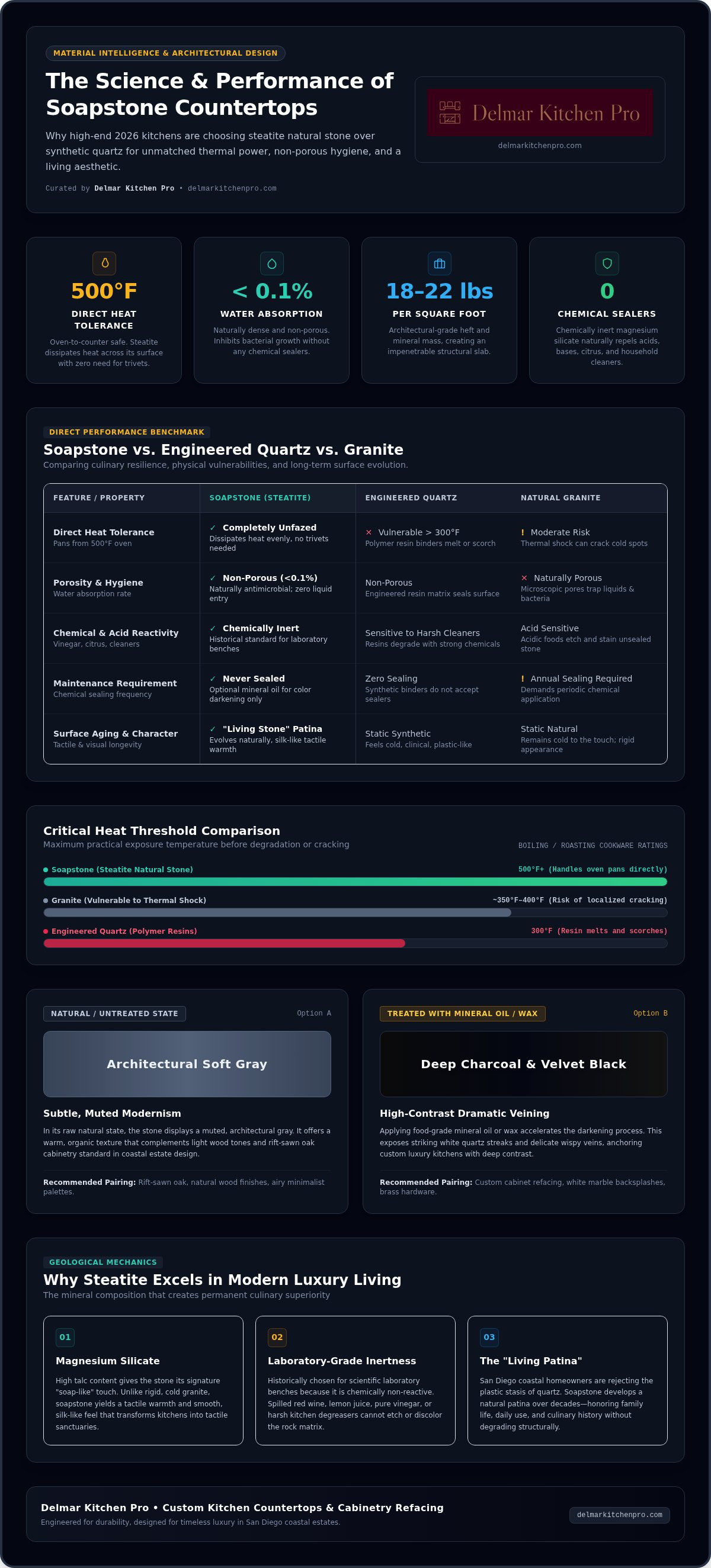
The beauty of soapstone lies in its versatility. In its raw state, the stone typically displays a soft, architectural gray. It's a muted, sophisticated look that pairs perfectly with rift-sawn oak or the light wood tones found in Del Mar estates. However, you aren't stuck with one look. Applying food-grade mineral oil or wax transforms the surface into a rich, deep charcoal or even a velvet black. This process highlights the stone's unique veining. Some slabs feature subtle, wispy lines, while others boast dramatic white streaks that cut through the dark background. This natural range allows us to integrate soapstone countertops into almost any design palette, from modern minimalist to warm traditional styles.
The Science of the "Living Stone": Composition and Properties
Soapstone's unique properties come from its mineral makeup. It's primarily magnesium silicate, better known as talc. While artistic varieties are soft, the architectural-grade stone used for soapstone countertops is dense and heavy. It typically weighs between 18 and 22 pounds per square foot. This density is the foundation of its longevity. It creates a surface that's essentially a solid, impenetrable mass, which is why it has been a staple in high-use environments for generations.
For centuries, this material was the standard for laboratory tables. Scientists chose it because it's chemically inert. It doesn't react with harsh acids or bases. In a modern kitchen, this means your counters won't be damaged by spilled vinegar, lemon juice, or household cleaners. You're getting a surface that was literally built for the most demanding environments in history. When evaluating the durability and performance of soapstone countertops, these scientific roots provide deep peace of mind for the home chef.
Heat Resistance: The Ultimate Culinary Surface
You can take a boiling pot of pasta or a tray of roasted vegetables directly from a 500-degree oven and set it on the stone. There's no need for a trivet. Steatite has incredible thermal mass and dissipates heat evenly across its surface. Other materials struggle with this level of intensity. Granite can crack from thermal shock if a cold spot meets a hot pan. Quartz is even more vulnerable; its polymer resin binders can melt or scorch at temperatures above 300 degrees. Soapstone remains unfazed, making it the most reliable surface for active cooking.
Impermeability: Why Sealing is Never Required
Most natural stones are like sponges. Granite and marble have microscopic pores that trap liquids and bacteria. This is why they require annual chemical sealing to prevent staining and deep contamination. Soapstone is different. It's naturally non-porous with a water absorption rate of less than 0.1 percent. This makes it naturally antimicrobial. Bacteria have no place to hide. Acidic spills like red wine or citrus won't etch the surface. You get a clean, safe preparation area without the need for synthetic sealants or toxic impregnators. Our team can help you integrate these high-performance surfaces into a luxury custom kitchen designed for your specific lifestyle.
Performance Comparison: Soapstone vs. Granite and Quartz
When you choose a countertop, you're making a long-term investment in your home's functionality. Many homeowners gravitate toward quartz because it offers a "perfect" out-of-the-box look. However, that perfection is often fragile. Quartz is a manufactured product held together by polymer resins. These resins can scorch, and once damaged, they're nearly impossible to repair. Granite is a natural alternative, but its porous nature requires constant chemical maintenance to prevent deep stains. Understanding the benefits and characteristics of soapstone countertops reveals a different kind of value. It's a material that doesn't just sit in your kitchen; it works with you.
The biggest advantage of soapstone is its repairability. If you drop a heavy cast-iron skillet on granite and it chips, you'll need a professional with epoxy to hide the damage. If you scratch soapstone, you can often fix it yourself. This "Sand and Buff" advantage is unique to this material. A small piece of 220-grit sandpaper and a dab of mineral oil can erase most surface marks in minutes. From an environmental standpoint, soapstone is also the cleaner choice. In 2026, we're seeing a significant shift away from resin-heavy quartz toward natural dimension stones that don't rely on synthetic binders or toxic sealants.
Durability vs. Delicacy: The Scratch Debate
It's time to address the "softness" myth. Architectural-grade soapstone is not delicate. While it sits lower on the Mohs scale than granite, it's structurally dense and won't shatter or crack from daily use. Yes, it will scratch. You should expect this. These marks aren't flaws; they're the beginning of a rich patina. For many, this evolving surface is a protective layer of history. If a scratch bothers you, a quick application of mineral oil usually makes it disappear. You aren't fighting the stone to keep it looking new. You're allowing it to age gracefully.
Maintenance Realities: Oiled vs. Unoiled
You have total control over the final aesthetic of soapstone countertops. A dry, unoiled surface stays a soft, milky gray. This "raw" look is currently trending in San Diego coastal homes because it feels organic and bright. If you prefer a more dramatic look, applying soapstone wax or mineral oil will turn the stone a deep, charcoal black. During the first year, you might oil the stone once a month to keep the color even. After the stone saturates, maintenance drops to once or twice a year. It's a simple, non-toxic process that keeps your kitchen looking curated and intentional.
Design Integration: Pairing Soapstone with Custom Cabinetry
Soapstone countertops serve as a grounding element in a luxury kitchen. They possess a visual weight that synthetic materials can't replicate. In many of our San Diego projects, we use a single, massive slab to anchor a kitchen island. This creates a focal point that feels permanent and intentional. Because architectural soapstone is heavy, weighing up to 22 pounds per square foot, structural integrity is our first priority. We ensure that every cabinet box is reinforced to handle the load. This prevents the stone from shifting or the cabinetry from bowing over time. It's a level of precision that only a seasoned master craftsman provides.
Contrast is the key to a luxury aesthetic. We often pair deep charcoal stone with light cabinet refacing to create a high-contrast look that feels both modern and timeless. This balance of light and shadow defines the space without making it feel small. For a truly seamless design, we also integrate custom soapstone sinks. This is the modern evolution of the farmhouse style. It eliminates the visual break between the counter and the basin, creating a unified surface that's as functional as it is beautiful. If you're ready to see how these elements work together, you can explore our options for a luxury custom kitchen designed for your home.
Color Theory: Balancing the Dark Tones
Don't assume soapstone is just black. Depending on the quarry, it often reveals subtle green or blue undertones. We recommend using under-cabinet lighting to bring these hidden colors to the surface. When it comes to cabinetry, soapstone looks exceptional against natural wood grains like walnut or rift-sawn white oak. If you prefer painted cabinets, deep earth tones or creamy whites offer the best backdrop. Hardware choice also matters. Brass and copper provide a warm, classic contrast, while matte black hardware creates a sophisticated, monochromatic feel that suits contemporary coastal homes.
Edge Profiles for the Modern San Diego Home
The edge profile you choose dictates the kitchen’s personality. For a contemporary coastal look in Del Mar, we often recommend an "Eased Edge." It's clean, simple, and lets the stone's natural veining take center stage. If you're designing for a traditional Rancho Santa Fe estate, a "Roman Ogee" edge adds a layer of architectural detail that feels right at home. We also help you decide between 2cm and 3cm slab thicknesses. A 3cm slab provides a substantial, high-end presence that immediately signals quality and longevity to anyone who enters the room.
Professional Installation and Care for San Diego Homeowners
Fabrication is the moment of truth for any kitchen remodel. It's the most critical stage in the journey of your soapstone countertops. While this stone is dense, it requires a specialized touch to ensure the final result meets luxury standards. We focus heavily on the precision of the joints. In a high-end build, you want seams that are virtually invisible, disappearing into the natural flow of the stone's veining. We've spent over 25 years perfecting this process, ensuring that the transition between slabs is as smooth as the surface itself. A master craftsman understands that the stone's beauty is only as good as the structural support beneath it.
San Diego’s coastal environment introduces specific variables that inland installers often overlook. If you live in Del Mar or La Jolla, the salt air and shifting humidity levels will interact with your stone. You might notice that mineral oil seems to "dry out" or evaporate faster during the first few months. This isn't a defect in the material. It's the stone acclimating to the coastal atmosphere. During the first 30 days, your new surface will undergo a natural oxidation process. You'll see the color deepen and the patina begin to take hold, marking the start of its life as a "living" part of your home.
The Delmar Kitchen Pro Installation Standard
Our installation process is built on a foundation of transparency and technical precision. As a licensed contractor (License #892702), we don't rely on guesswork. We use advanced digital templating to ensure an exact fit with your custom cabinetry. This is especially important when integrating soapstone sinks or complex edge profiles. We take a hands-on approach to slab selection, personally inspecting bundles to find the most evocative veining for your specific layout. We believe in stress-free project management. You'll receive clear communication at every milestone, from the initial template to the final buffing of the stone.
Long-Term Care in a Coastal Climate
Maintaining your counters is straightforward, but consistency matters in a coastal climate. For daily cleaning, stick to mild dish soap and warm water. It's best to avoid harsh chemical cleaners or abrasive degreasers, as these can strip away the natural oils and dull the patina. If you find that standard mineral oil isn't holding up against the ocean breeze, we often recommend a dedicated soapstone wax. These blends of beeswax and carnauba oil provide a more durable barrier against the elements. If your counters ever lose their luster or sustain a deep scratch, we offer a professional refresh service to restore the stone to its original, silk-like condition.
Build Your Legacy Kitchen with Natural Stone
Choosing the right surface for your home is about more than just aesthetics. It's about selecting a material that can handle the heat of a busy kitchen while aging with grace. soapstone countertops provide a unique combination of silk-like texture and industrial-grade durability that synthetic alternatives can't replicate. By embracing the natural patina of this living stone, you're investing in a kitchen that feels grounded and authentic.
Our team brings over 25 years of luxury remodeling experience to every project. As a licensed San Diego contractor (#892702), we specialize in coastal kitchen transformations that balance beauty with structural integrity. We understand how to pair premium stone with custom cabinetry to create a space that reflects your personal style. We take the logistical burden off your shoulders, ensuring a seamless journey from the first slab selection to the final installation.
Ready to transform your home? Schedule Your Custom Kitchen Design Consultation in San Diego today. We look forward to helping you create a kitchen that stands the test of time.
Frequently Asked Questions
Does soapstone stain easily from wine or oil?
No, soapstone is naturally non-porous and doesn't stain. Unlike marble or granite, it has a water absorption rate of less than 0.1 percent. Red wine, lemon juice, and oils stay on the surface rather than soaking into the stone. This makes it a highly hygienic choice for kitchens in La Jolla and Del Mar. If you see a dark spot from oil, it's just surface oxidation that's easily wiped away.
How often do I really need to oil my soapstone countertops?
Oiling is strictly an aesthetic choice to darken the stone. If you prefer a deep charcoal look, you might apply food-grade mineral oil once a month during the first year. Over time, the stone becomes saturated and requires treatment only once or twice a year. Many homeowners in Rancho Santa Fe now choose to leave their soapstone countertops raw for a natural gray finish that requires no oiling at all.
Can I cut directly on a soapstone surface?
You can cut on it without damaging your knives, but we don't recommend it. Soapstone contains talc, which makes it softer than granite or quartz. Direct cutting will leave visible scratches on the surface. While these marks are easy to sand out, using a cutting board preserves the smooth, silk-like finish. This simple habit ensures your custom kitchen remains in top condition and protects the long-term value of your investment.
Is soapstone more expensive than high-end marble or granite?
Soapstone typically falls into the same price bracket as high-end granite or premium marble. While it's more of an investment than basic granite or engineered quartz, it offers unique benefits like heat resistance and chemical inertness. For San Diego estates, the value lies in its longevity and the fact that it never needs chemical sealing. It's a premium material that adds distinct character and value to a luxury custom kitchen build.
What happens if I chip the edge of my soapstone counter?
Small chips can be easily repaired by a homeowner or a professional. Because the stone is consistent throughout its thickness, you can sand down a minor chip with 80-grit to 220-grit sandpaper until it blends into the edge. For larger chips, a master craftsman can use stone dust and epoxy for a seamless fix. This repairability is a major advantage over quartz, which often requires complex and expensive professional interventions to hide damage.
Why is soapstone considered a "living" surface?
It's called a living surface because it evolves based on how you use your kitchen. Over time, the stone develops a natural patina, darkening in high-use areas and softening in texture. This isn't a sign of wear but a record of your home's history. Unlike static, manufactured surfaces, soapstone countertops gain character and depth as they age. This organic transformation is a hallmark of the "Quiet Luxury" design trend across Southern California.
Can soapstone be used in outdoor kitchens in San Diego?
Yes, soapstone is an excellent choice for outdoor kitchens in Encinitas and Del Mar. It's completely unaffected by UV rays, so it won't fade in the California sun. Since it's non-porous, it handles rain and coastal humidity without the risk of mold or cracking. Its incredible thermal mass also means it won't get as hot to the touch as darker granites, making it a safer surface for outdoor food preparation.
How do I choose between the different varieties of soapstone?
Your choice depends on your lifestyle and design goals. Architectural-grade varieties have lower talc content and are harder, making them ideal for high-traffic kitchens. You should also consider the veining patterns. Some slabs offer dramatic, sweeping white lines, while others have a more subtle, uniform look. We recommend visiting our local partners to see full slabs in person. This ensures the stone's natural movement aligns perfectly with your custom cabinetry and aesthetic.


