

Your choice between marble vs quartz countertops is rarely about aesthetics alone. It is a decision about how you live and how you define perfection in your home. Some homeowners see a natural patina as a story of a life well-lived. Others want a surface that looks exactly the same on day one thousand as it did on day one. Both perspectives are valid, but they lead to very different material choices for a luxury remodel.
We understand the hesitation that comes with selecting high-end materials for a coastal kitchen. You don't want to spend your evenings worrying about wine stains or how salt air and humidity might affect a porous surface. You deserve a space that reflects your standards without becoming a constant maintenance burden. Our goal is to provide the transparency you need to protect your investment and your peace of mind.
This guide offers a definitive comparison of these two premium surfaces. You will find a clear decision framework based on durability, maintenance, and long-term performance. We will help you determine if the character of natural stone or the precision of engineered quartz is the right fit for your custom kitchen transformation.
Key Takeaways
- Understand the fundamental differences between natural metamorphic stone and high-performance engineered surfaces to set realistic expectations for your kitchen.
- Learn how porosity and hardness ratings affect daily performance against common household spills and potential scratches.
- Evaluate the visual depth of natural veining against the pattern consistency required for large kitchen islands and waterfall edges.
- Use our decision framework for marble vs quartz countertops to determine which material offers the best long-term investment for your San Diego home.
- Identify the critical structural requirements for installing heavy stone slabs and how to integrate them seamlessly with custom cabinet solutions.
Understanding the Duel: What Are Marble and Quartz Countertops?
The debate between marble vs quartz countertops begins with a fundamental choice: do you want a piece of Earth's history or a marvel of modern engineering? This decision dictates more than just the color of your kitchen. It influences the structural support your cabinets require and the daily rhythm of your home maintenance. One material is a living finish, while the other is a high-performance tool designed for consistency. It's a choice between geological unpredictability and industrial precision.
The Origin of Marble
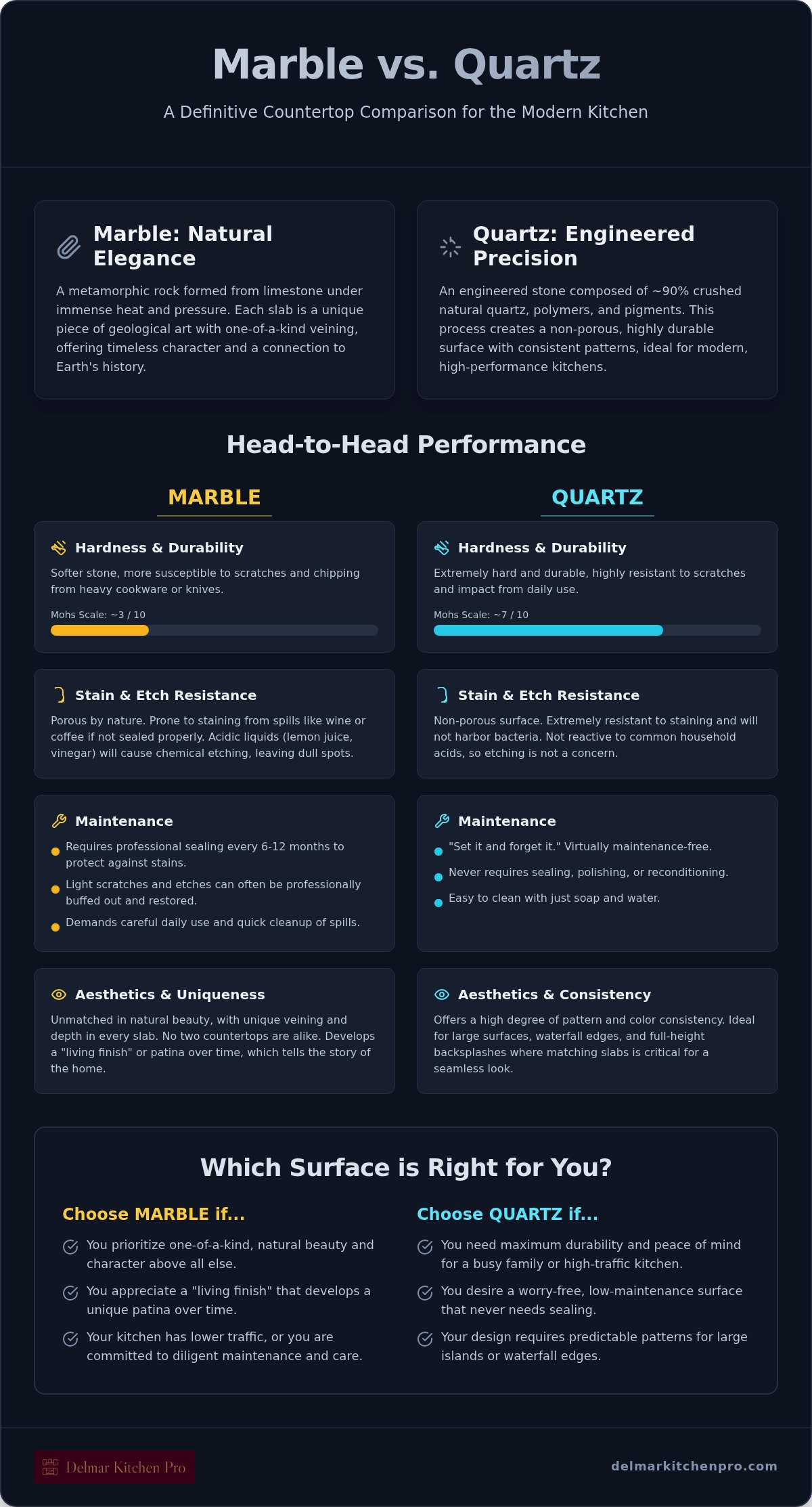
Marble is a metamorphic rock that starts its life as limestone. Over millions of years, intense heat and pressure deep within the crust recrystallize the stone. This process creates the signature veining and translucent depth that have defined luxury architecture for centuries. Because it's forged by geological forces, every slab is a unique piece of art. You aren't just buying a surface; you're acquiring a one-of-a-kind specimen that cannot be replicated. This historical prestige is why marble remains a top choice for high-end coastal kitchen transformations where character is paramount.
The Engineering of Quartz
Quartz takes a different path. It is an Engineered stone created by combining roughly 90% crushed natural quartz with high-performance polymer resins and pigments. This industrial process eliminates the natural fissures and pores found in raw stone. In 2026, technology has advanced to a point where quartz can mimic the dramatic, flowing veins of rare marble varieties with startling accuracy. The result is a surface that offers the visual warmth of nature with the predictable durability of a factory-tested product. It provides a level of pattern consistency that is essential for large-scale projects like waterfall islands where multiple slabs must match perfectly.
Choosing between these two involves balancing your desire for natural authenticity against your need for functional reliability. A master craftsman understands that marble requires a commitment to its "living" nature. Quartz, conversely, offers a stress-reduction promise through its non-porous surface. Both are excellent choices for a luxury custom kitchen, provided the installation is handled with professional precision. The right choice depends on whether you value the story of the stone or the performance of the surface.
Performance and Durability: The Real-World Kitchen Test
In a high-traffic kitchen, durability is the difference between a relaxing evening and a stressful cleanup. When comparing marble vs quartz countertops, we start by looking at the Mohs scale of mineral hardness. Quartz typically ranks around a 7. This rating makes it highly resistant to scratches from stainless steel knives or heavy cast iron cookware. Marble sits lower on the scale, usually around a 3. This means it's a softer stone that will show physical wear and tear more quickly under daily use.
The concept of the "living finish" is central to the marble experience. Over years of use, marble develops a patina. Some homeowners find this aged look beautiful, as it reflects the history of their home. Others prefer the industrial precision of a surface that never changes. Understanding your own relationship with perfection is the first step in choosing between these two premium materials for marble vs quartz countertops.
The Challenge of Marble Maintenance
Marble owners must prepare for etching. This is the most common concern we hear from clients. Etching isn't a stain; it's a chemical reaction. When acidic liquids like lemon juice, vinegar, or red wine hit the surface, they dissolve a tiny layer of the calcium carbonate in the stone. This leaves a dull, light-colored mark that remains even after the liquid is wiped away.
- Professional Sealing: You should seal marble every six to twelve months to prevent deep liquid staining.
- Etch Prevention: While seals help with stains, they don't prevent chemical etching from acids.
- Repairability: Because marble is a natural, solid stone, a professional can often buff out light scratches or etch marks to restore the finish.
The Resilience of Quartz
Quartz offers a "set it and forget it" appeal for busy households. It's an engineered, non-porous surface that resists liquid penetration entirely. This makes it exceptionally hygienic, as there are no microscopic pores where bacteria or mold can grow. You never have to seal it, and it won't react to acidic foods like lemon or tomatoes.
However, quartz has a specific limitation: thermal shock. The resins used to bind the crushed stone can scorch or crack if exposed to extreme heat. A hot pot taken directly from the stove can leave a permanent mark. While marble is naturally heat-resistant, quartz requires the disciplined use of trivets to protect the resin. If you're planning a luxury custom kitchen, we can help you weigh these practical trade-offs against your design goals to ensure your investment lasts for decades.
Aesthetic Impact: Natural Veining vs. Engineered Consistency
The visual soul of your kitchen often rests on the slab you select. When deciding between marble vs quartz countertops, you are choosing between the organic movement of nature and the curated precision of human design. Marble possesses a unique, translucent depth. Light travels into the stone before reflecting back, giving it a glow that engineered materials often struggle to replicate. This visual "breathing" makes the kitchen feel grounded and authentic.
Quartz offers a different kind of beauty. It provides a level of control that nature cannot guarantee. For large-scale projects like grand islands or expansive waterfall edges, quartz is often the superior choice. You can select multiple slabs with the confidence that the patterns will align perfectly. In 2026, the gap between these materials is narrowing, but the choice still defines the atmosphere of your custom build.
The Timeless Appeal of Natural Marble
Every marble slab tells a story of its geological journey. The "movement" of the veins is entirely unpredictable, creating a dynamic energy in the room. This uniqueness is the hallmark of luxury. When you choose natural stone, you accept that no other kitchen in the world will look exactly like yours. There is a deep emotional connection to using authentic materials. It feels substantial. It feels permanent. For many homeowners, the slight imperfections in the veining are not flaws, but proof of the material's prestigious origin.
Modern Quartz Innovations
Technology in 2026 has transformed the way we view engineered surfaces. High-quality quartz now features "through-body" veining. This means the pattern is not just printed on the surface but runs through the entire thickness of the slab. This innovation is critical for modern designs. It allows for realistic edge profiles and seamless waterfall transitions where the veining flows vertically toward the floor.
Identifying the difference between high-quality and low-quality quartz is essential for protecting your investment. You can spot a premium product by looking at the edges and the depth of the pattern. Low-quality options often look like a photograph applied to the top of the stone. They lack the crystalline shimmer found in better versions. High-quality quartz mimics the subtle color shifts of natural stone, offering a sophisticated palette that ranges from classic Carrara whites to the bold, smoky charcoals trending this year. This consistency allows you to plan your Luxury Custom Kitchen with absolute certainty, knowing the final result will match your vision exactly.
The Luxury Investment: ROI and Value in San Diego
In San Diego’s luxury real estate market, the choice between marble vs quartz countertops is a frequent discussion during high-end appraisals. Properties in La Jolla or Del Mar demand a level of finish that matches the coastal scenery. Buyers here are sophisticated. They recognize the difference between a standard renovation and a masterfully crafted kitchen. Your choice of surface acts as a visual anchor that either elevates or diminishes the surrounding custom elements.
Coastal environments present unique challenges. Salt air and persistent humidity can penetrate porous materials more aggressively than in drier climates. While marble is a classic choice, its sealants must be monitored closely in beachfront homes to prevent moisture from clouding the stone. Quartz provides a reliable alternative. Its non-porous nature acts as a barrier against the elements. It ensures the surface remains pristine without the need for frequent professional intervention. This durability is a significant selling point for homes exposed to the Pacific breeze.
Market Expectations in Rancho Santa Fe
In the expansive estates of Rancho Santa Fe, natural stone remains a symbol of material authenticity. Many buyers in this bracket expect the weight and history of natural marble. It suggests a home built with permanent, high-quality materials. However, the luxury standard is shifting. High-performance quartz is now widely accepted because it supports the bold, seamless designs that modern architecture requires. It allows for massive islands and intricate edge profiles that might be structurally risky with natural stone slabs. Authenticity matters, but so does performance.
Cost vs. Long-Term Value
Evaluating a 25-year kitchen investment requires looking past the initial installation. You must consider the labor involved in maintaining a living finish like marble. Over a decade, the cost of professional sealing and occasional restoration can be significant. Quartz offers a different kind of value: predictability. It is the preferred choice for luxury rental properties or vacation homes in Del Mar where you cannot control how guests treat the surfaces. It provides a durable result that protects your equity while offering a stress-free ownership experience.
If you are ready to start your Luxury Custom Kitchen project, we can guide you through a selection process that balances aesthetic desires with long-term property value.
The Master Craftsman’s Verdict: Choosing for Your Custom Kitchen
The final decision in the marble vs quartz countertops debate often comes down to the physical execution of your project. As a builder, I look beyond the surface beauty to the structural reality of your kitchen. A standard 3cm stone slab can weigh between 15 and 20 pounds per square foot. This weight requires a foundation of high-quality cabinetry that is perfectly level and structurally sound. Before we place a single piece of stone, we must ensure your cabinet boxes can support the immense load without shifting or bowing over time.
Professional installation is just as critical as the material itself. The most expensive marble slab can look mediocre if the seams are poorly placed or the edges don't align with the cabinetry. We use digital templating to ensure a precise fit against your walls and around custom sinks. This level of detail is what separates a standard remodel from a true Luxury Custom Kitchen. Your fabricator should be a partner who understands how to hide seams in the veining and how to reinforce overhangs for seating areas safely.
Coordinating with Custom Cabinetry
If you are considering a cabinet reface or professional cabinet painting, your countertop choice dictates your color palette. Marble often has cool, gray undertones that pair beautifully with crisp whites or deep navy blues. Conversely, many 2026 quartz collections offer warmer, sandy tones that complement natural wood finishes or mushroom-colored paints. We recommend selecting your stone first. It's much easier to tint a paint to match a vein in your marble than it is to find a slab that matches a pre-painted cabinet.
The edge profile also plays a role in design harmony. A modern kitchen often utilizes a mitered "waterfall" edge that makes the slab appear six inches thick. A traditional home in Rancho Santa Fe might call for a classic ogee or bullnose edge to match ornate cabinet door styles. These details ensure that the countertop feels like an integrated part of the architecture rather than an afterthought.
Final Decision Checklist
Before you sign a contract for your marble vs quartz countertops, ask yourself these essential questions to ensure long-term satisfaction:
- Am I prepared to seal my surfaces every year, or do I need a maintenance-free solution?
- Does my kitchen design require multiple slabs that need perfectly matched patterns?
- Will the "living finish" and inevitable etching of marble bother me, or will I appreciate the patina?
- Is my home located in a coastal area where salt air might affect natural stone sealants?
Selecting the right material is a personal journey, but you don't have to navigate it alone. A local San Diego expert can help you feel the textures and see the true colors of these stones in person. Schedule a consultation with Delmar Kitchen Pro to see material samples in person. We will help you weigh the structural requirements and aesthetic goals of your project to create a kitchen that stands the test of time.
Securing the Future of Your Kitchen
Your choice between marble vs quartz countertops defines the long-term character of your home. You now understand that marble offers an irreplaceable natural character, while quartz provides the predictable durability required for a modern coastal kitchen. Your decision should reflect your daily lifestyle and how you value the evolution of your surfaces over time. Whether you choose the living patina of stone or the industrial precision of engineered quartz, the quality of the installation remains the most critical factor for success.
We are here to ensure your vision is executed with technical excellence. Delmar Kitchen Pro brings over 25 years of local craftsmanship to every project. As a licensed San Diego contractor (License #892702), we provide full-service design and construction management to handle every logistical detail. We believe in transparency and high standards, ensuring your home remains a place of comfort and pride for decades. Our goal is to take the weight off your shoulders so you can focus on the results.
Start Your Luxury Kitchen Transformation with Delmar Kitchen Pro. We look forward to building a space that matches your standards and protects your investment.
Common Questions About Luxury Surfaces
Does marble or quartz increase home value more in San Diego?
High-end San Diego buyers often expect natural stone in certain price brackets, but quartz is currently favored by 78% of industry professionals for its reliability. While a minor remodel in San Diego can see an ROI between 87.7% and 96%, the choice between marble vs quartz countertops should align with your specific neighborhood. In La Jolla, marble might offer a slight edge in perceived prestige, whereas quartz appeals to those prioritizing long-term durability.
Can I put hot pans directly on a quartz countertop?
You should never place hot pans directly on a quartz surface. While the material is heat-resistant, the polymer resins used to bind the crushed stone are susceptible to thermal shock. Sudden temperature changes can cause the resin to discolor or even crack. We always recommend using trivets or hot pads to protect your investment. This simple habit ensures your engineered surface remains pristine and free from permanent scorch marks for decades.
How often do I really need to seal my marble countertops?
We recommend sealing your marble countertops every six to twelve months. In coastal areas where humidity levels fluctuate, you may need to apply a high-quality impregnating sealer more frequently. You can perform a simple water test by placing a few drops on the surface. If the water beads up, the seal is intact. If it absorbs into the stone within a few minutes, it's time for a professional re-sealing to prevent deep stains.
Is quartz more environmentally friendly than natural marble?
Both materials have distinct environmental profiles. Quartz is often considered eco-friendly because it uses crushed stone waste and recycled materials. However, the manufacturing process involves synthetic resins and high energy consumption. Natural marble is a raw Earth product but requires significant energy for quarrying and international transport. When selecting between marble vs quartz countertops, consider local sourcing and the material's longevity. A surface that lasts 25 years is always more sustainable than one requiring frequent replacement.
Why is my marble countertop etching even though it was sealed?
Etching is a chemical reaction that occurs regardless of whether the stone is sealed. Sealing only fills the pores of the stone to prevent liquids like red wine from soaking in and causing a deep stain. Etching happens on the surface when acidic substances like lemon juice react with the calcium carbonate in the marble. This reaction dissolves a tiny layer of stone, leaving a dull mark. Professional honing is the only way to remove these marks.
Can quartz be used for outdoor kitchens in coastal areas like Encinitas?
Quartz is not recommended for outdoor use in coastal San Diego. The intense Southern California sun and UV rays will eventually cause the resins in the quartz to yellow and degrade. While the material handles salt air well, the direct exposure to the elements in Encinitas makes natural stone a better choice for outdoor kitchens. For these spaces, we typically suggest granite or quartzite, which can withstand both the sun and the coastal humidity without fading.
What is the most durable marble for a high-traffic kitchen?
If you prioritize durability in a natural stone, look for "hard" marbles or dolomitic stones. Vermont Danby marble is a frequent recommendation because it is denser and less porous than many Italian varieties. While all marble requires care, denser stones provide a slightly better defense against moisture and physical wear. We can help you select a slab that offers the aesthetic you want while providing the best possible performance for a high-traffic luxury kitchen environment.
How do I tell the difference between high-quality and low-quality quartz?
You can identify premium quartz by examining the veining and the edges of the slab. High-quality engineered stone features "through-body" veining where the pattern continues all the way through the material rather than just being printed on top. Look closely at the crystalline structure. Cheaper options often look flat or pixelated, while premium slabs have a depth that mimics natural stone. Superior quartz will also have a more consistent finish across the entire surface and edges.


